Failure
A scattered locator path creates false-failure risk.

Locator Intelligence Lab · Real proof sequence
We intentionally created a framework containing poor locator practices and then allowed QA ALIGN to assess, repair, validate, and reassess the framework.
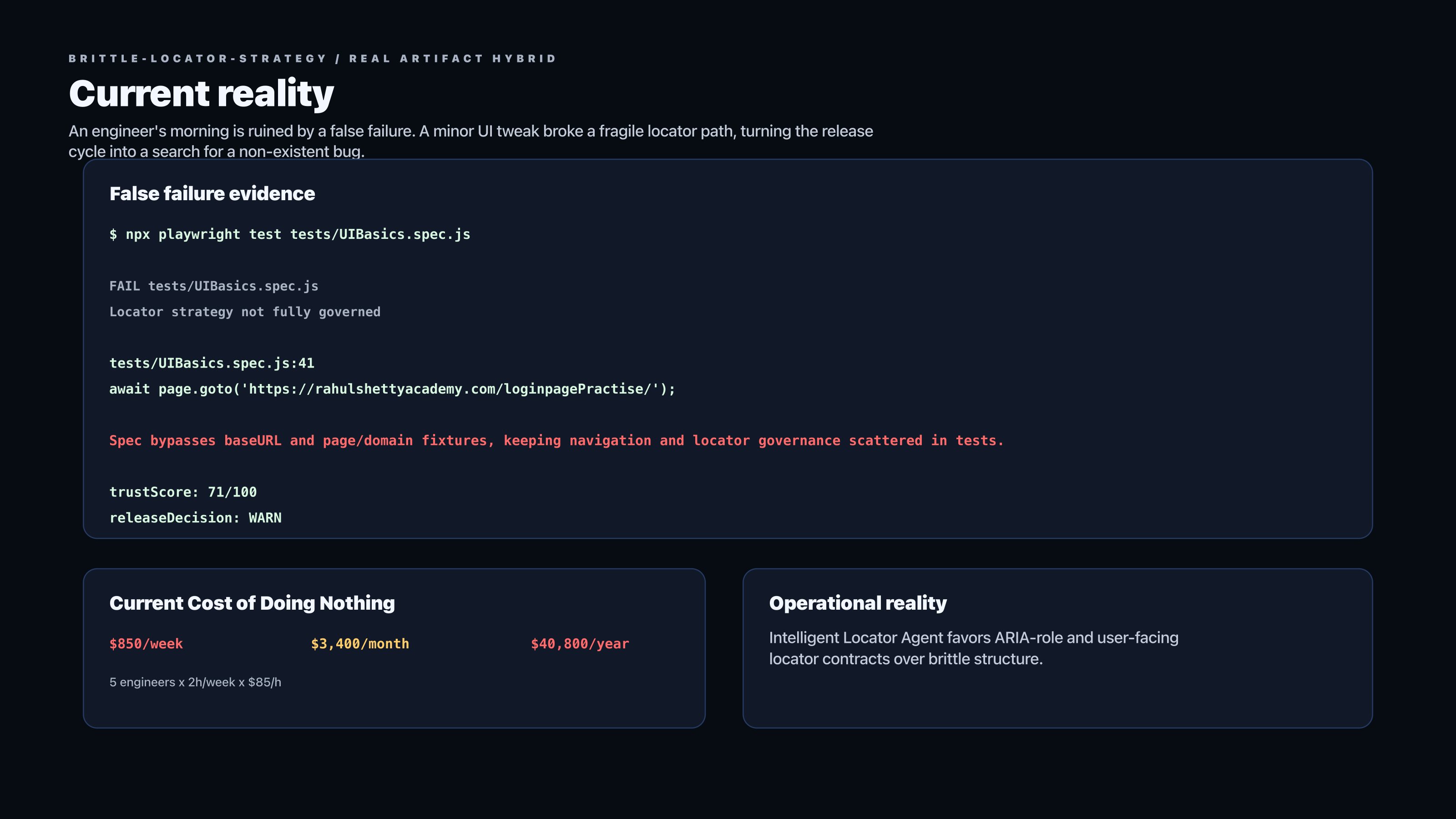
Experienced improving systems for








A scattered locator path creates false-failure risk.
The framework assessment names locator governance as the highest-risk issue.
A line-level fix card defines the smallest safe correction and verification command.
Locator Intelligence promotes a user-facing locator contract.
The repaired framework is independently assessed against the same risk model.
Locator governance leaves the top findings and the release moves from WARN to GO.
01 · Assessment report
The archived baseline report records a 71/100 trust score and a WARN release decision. Its top finding points to locator strategy that exists, but is not consistently governed.
Open the real assessment report →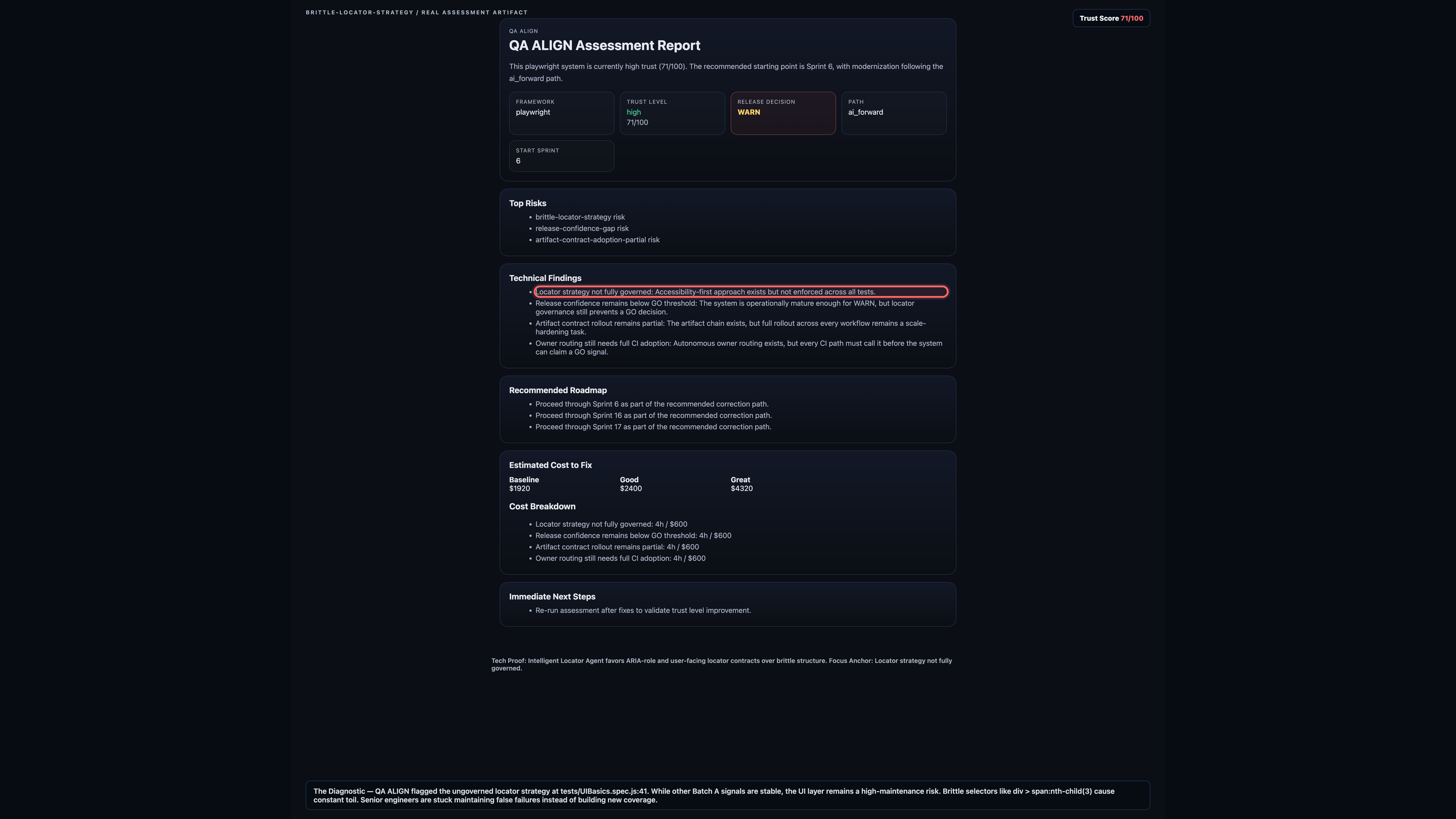
02 · Engineer fix plan
The internal plan identifies the affected line, proposes a user-facing role locator, credits the Intelligent Locator Agent, and defines the narrow verification command before reassessment.
await page.goto('.../loginpagePractise/'); Proposed contractpage.getByRole('button', { name: /sign in/i }) 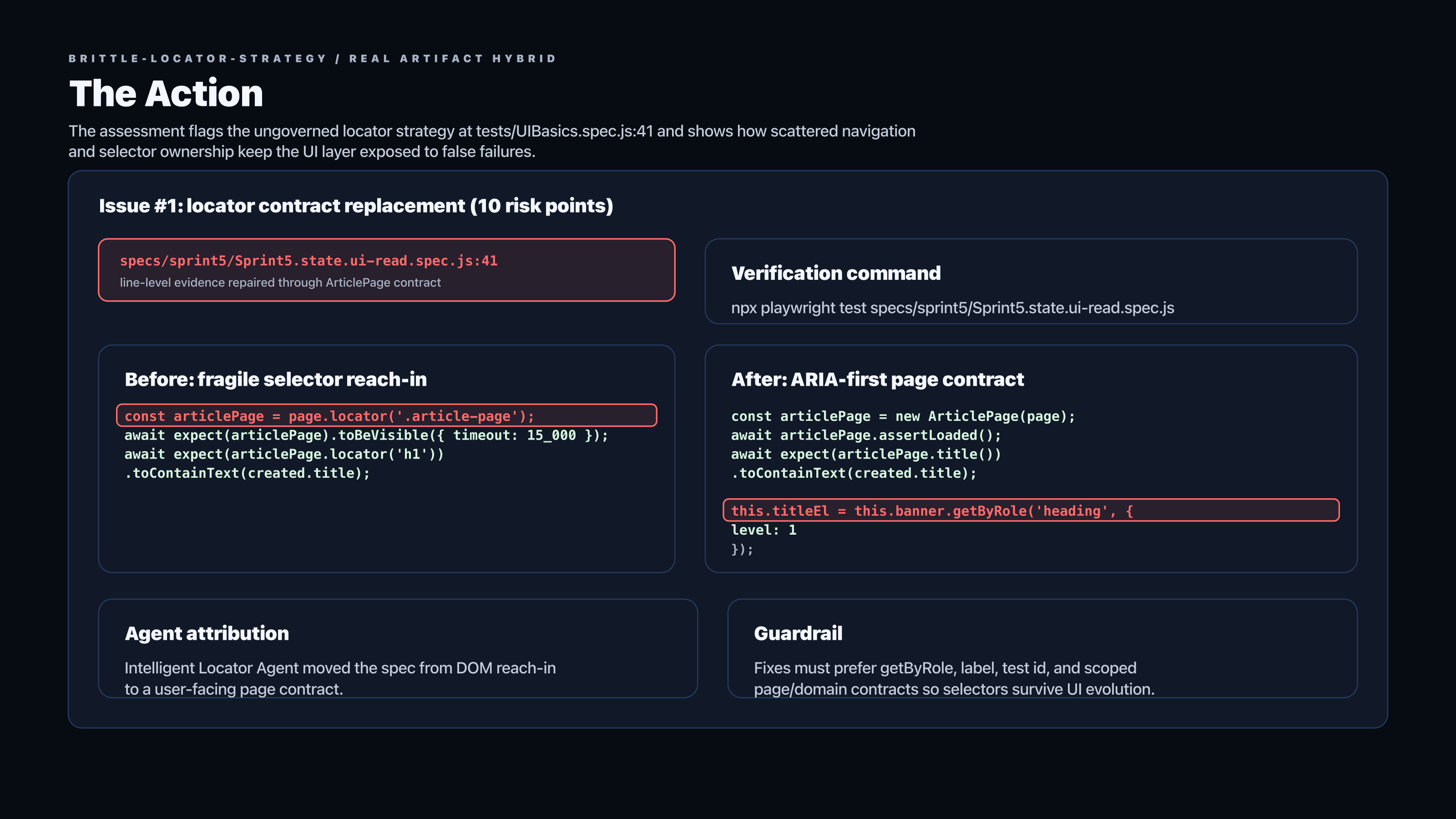
03 · Agent execution
The lab exposes the agent contract, not the proprietary implementation. A real finding enters; a validated locator contract exits.
Read the observed locator finding and affected source target.
Identify structural reach-in and missing user-facing locator governance.
Propose a role-and-name locator contract with a governed owner.
Run the narrow locator contract check, then reassess the framework.
tests/UIBasics.spec.js:41getByRole('button', { name: /sign in/i })04 · Independent validation
The after-assessment no longer lists locator governance as a top finding. The release becomes eligible for GO, while the next scale-hardening risk remains visible.
Open the locator validation report →Accessibility-first strategy exists but is not enforced across all tests.
71/100 · WARNARIA-first locator contracts are in place; scale hardening becomes the next risk.
80/100 · GO05 · Reassessment
Trust moves by nine points. The release decision moves from WARN to GO. The report does not claim perfection; it promotes scale hardening as the next governed risk.
Open the real reassessment report →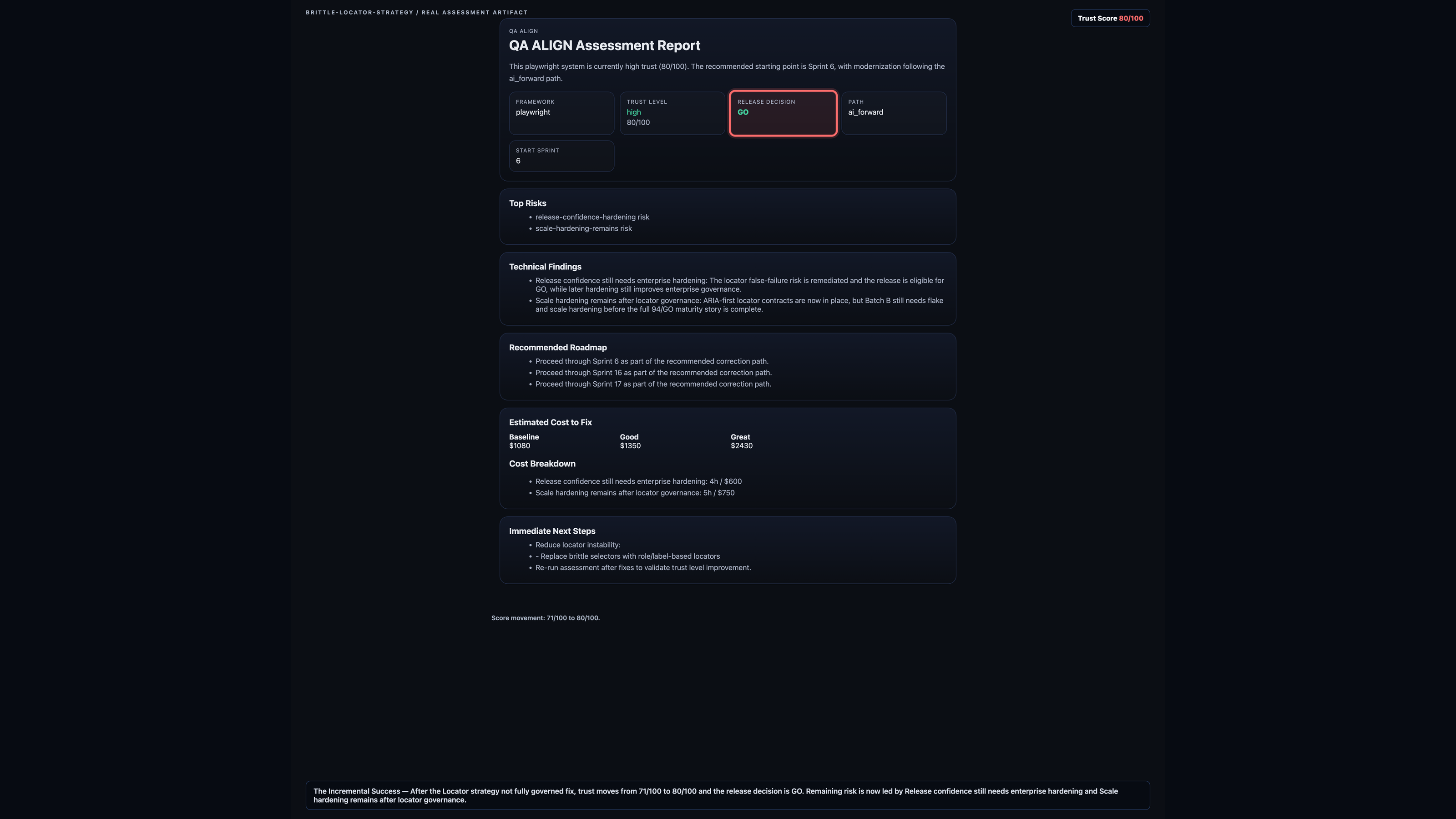
06 · Evidence package
Every card opens a real artifact or a source-cited manifest derived from the archived assessment pair.
71/100 WARN baseline naming locator governance as the highest-risk issue.
Open artifact →02Line-level remediation target, proposed contract, verification command, and agent attribution.
Open artifact →03Source-cited validation record without invented pass counts.
Open artifact →04Proof contract, source paths, repair boundary, and earned ending state.
Open artifact →05The exact trust, decision, fix-cost, and top-risk movement.
Open artifact →Assessment first
Send QA ALIGN one failing or unstable automation flow. We will identify whether locator governance is the highest-risk issue, what evidence supports that finding, and what it would cost to fix.
Best fit for teams with brittle selectors, flaky Playwright or Selenium tests, page object drift, or failures that reappear after UI changes.