







Assertion Noise

Stop Brittle Assertions from Hiding Real Release Proof

QA ALIGN reviews assertion patterns to identify checks that are brittle, low-value, duplicated, or disconnected from meaningful risk.

External report for the client. Internal engineer fix document is created after approval to accelerate remediation.

Experienced improving systems for:

What QA ALIGN queries

Anti-patterns hiding inside the current framework

  • Assertions validate unstable presentation details instead of behavior
  • Messages do not explain what risk the failure represents
  • Duplicate assertions increase failures without increasing confidence
  • Checks are too broad to identify the failing condition
  • Failures lack enough context to determine product versus test issue
What the client receives

An external report with issues, trust level, and prices

  • Detected framework anti-patterns with affected areas
  • Current framework trust level
  • Issue evidence and severity
  • Weighted prices to fix the recommended changes
  • Recommended first remediation path

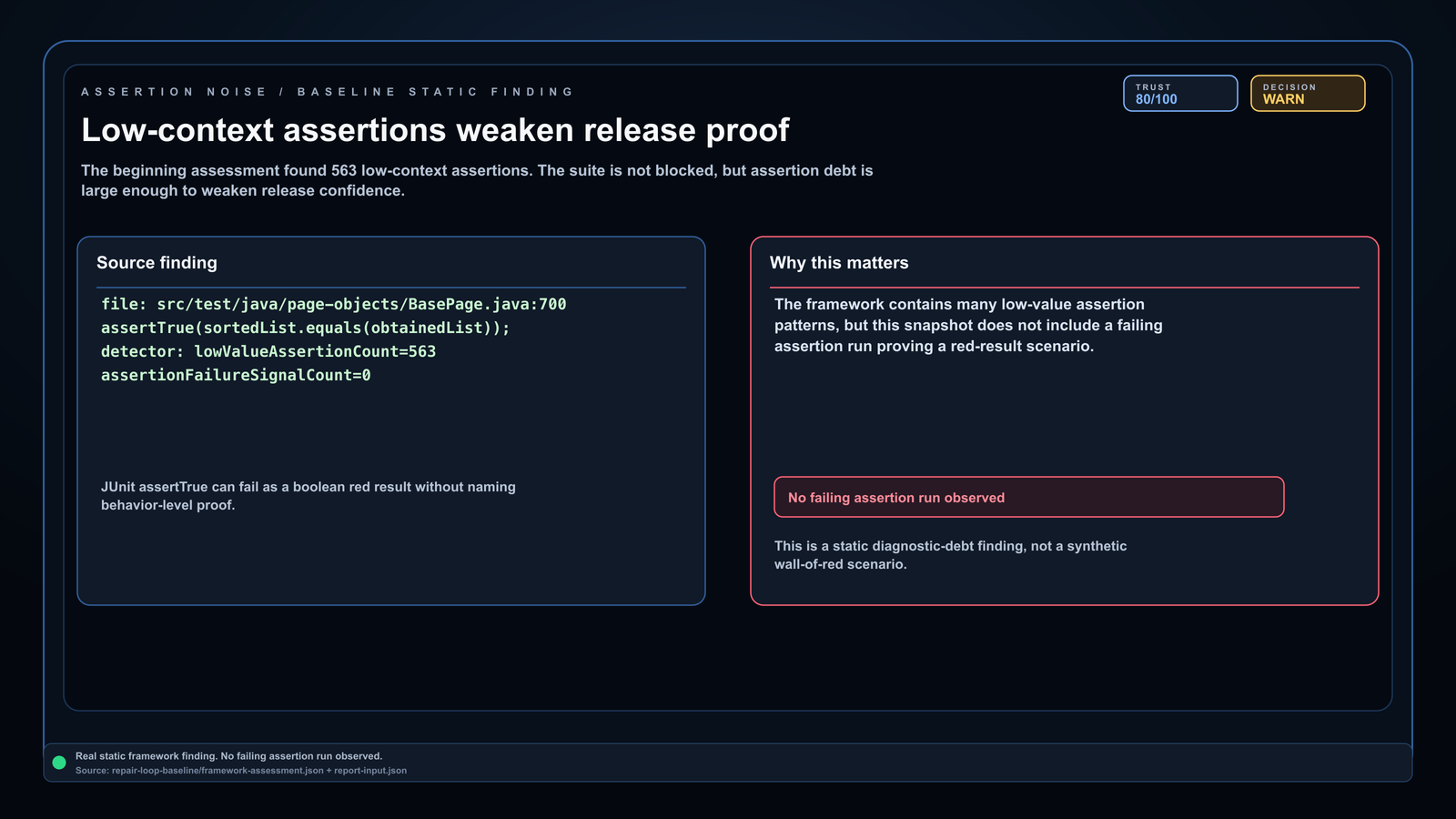
Sample finding

Assertions fail without explaining the risk

A useful assertion should produce evidence, not just a red result. QA ALIGN checks whether failures explain what changed and why it matters.

Detected anti-pattern

The report prices assertion improvements that make failures easier to understand and act on.

Current assessment scenario

Assertion Noise Repair Loop Story

QA ALIGN assessed a private Selenium/JUnit framework and found assertion debt before it became an execution mystery.

Assertion Noise Repair Loop Story assessment evidence preview
What QA ALIGN found

The beginning report scores the framework at 80/100 WARN with 563 low-context assertions. The controlled repair loop applies 560 safe assertion repairs, then the ending report shows 98/100 WARN with 19 residual assertions preserved for review.

Evidence reviewed
  • Assertion inventory
  • Low-context assertion count
  • Controlled assertion repair output
  • Beginning and ending advisory reports
  • Residual assertion review list
Assessment decision

Assertion debt is reduced without claiming a fake GO state. The final 19 low-context assertions become reviewable governance debt because safe automation should not guess at ambiguous test intent.

Durable operational capability

What Your Team Owns After This Engagement

QA ALIGN does not leave behind hours. The engagement leaves your team with operational assets, new framework capabilities, and measurable improvements it can continue using after the work ends.

The assessment selects a companion deterministic sprint grounded in established automation-engineering practices. The order matters: earlier sprints establish trusted signals, evidence, and controls, making each later improvement more valuable and easier to verify.

Companion sprint recommended by this assessment Controlled assertion repair loop

The detector found 563 low-context assertions that could fail without explaining the behavior, expected state, or observed state.

Assets your team owns
  • Assertion-quality detector audit
  • Behavior-level assertion contracts
  • Residual assertion review register
Capabilities your team gains
  • Safely repair high-confidence low-context assertions
  • Promote ambiguous assertion intent to human review instead of guessing
Operational improvements
  • Low-context assertions reduced from 563 to 19
  • Trust improved from 80/100 WARN to 98/100 WARN

Real static framework finding. No failing assertion run observed.

Report outcomes

Know what is breaking trust before buying remediation

  • See which assertion patterns are creating noise
  • Understand where checks should become stronger or narrower
  • Know which assertion fixes improve trust fastest
  • Review weighted pricing for assertion remediation
  • Give engineers a targeted internal fix document

Request the report

Only your email is required to begin. Add technical context only if it is useful.

Add optional context

Private intake. The external report is for your team. Internal engineer fix docs are not public-facing.