






Brittle Locator Strategy

Replace False Failures with Robust Locators

QA ALIGN reviews selector and locator patterns, then shows where CSS, XPath, positional targeting, ambiguous locators, and missing accessibility contracts are creating false UI failures.

External report for the client. Internal engineer fix document is created after approval to accelerate remediation.

Experienced improving systems for:

What QA ALIGN queries

Anti-patterns hiding inside the current framework

  • Selectors depend on DOM structure, CSS classes, or generated IDs
  • Tests rely on nth(), first(), broad text matches, or deep XPath chains
  • Tests do not use ARIA-first, user-facing, or test-specific contracts
  • Locator maps are missing, stale, or not revalidated against the live UI
  • Locator rules differ by author, feature area, or framework
  • Page object abstractions hide brittle selectors instead of improving them
  • Failures do not identify locator brittleness or strict-mode ambiguity as a separate category
What the client receives

An external report with issues, trust level, and prices

  • Detected framework anti-patterns with affected areas
  • Current framework trust level
  • Issue evidence and severity
  • Weighted prices to fix the recommended changes
  • Recommended first remediation path

Sample finding

Selectors are coupled to implementation details

When tests target unstable markup instead of reliable product behavior, harmless changes create false failures. QA ALIGN checks selector usage for repeatable brittleness, positional access, broad matches, missing accessibility contracts, and stale locator-map evidence.

Detected anti-pattern

The report prices locator fixes that improve signal without rewriting the entire suite, and the engineer fix document points to the highest-risk selectors, locator-map updates, and revalidation work first.

Current assessment scenario

Brittle Locator Strategy Client Assessment Story

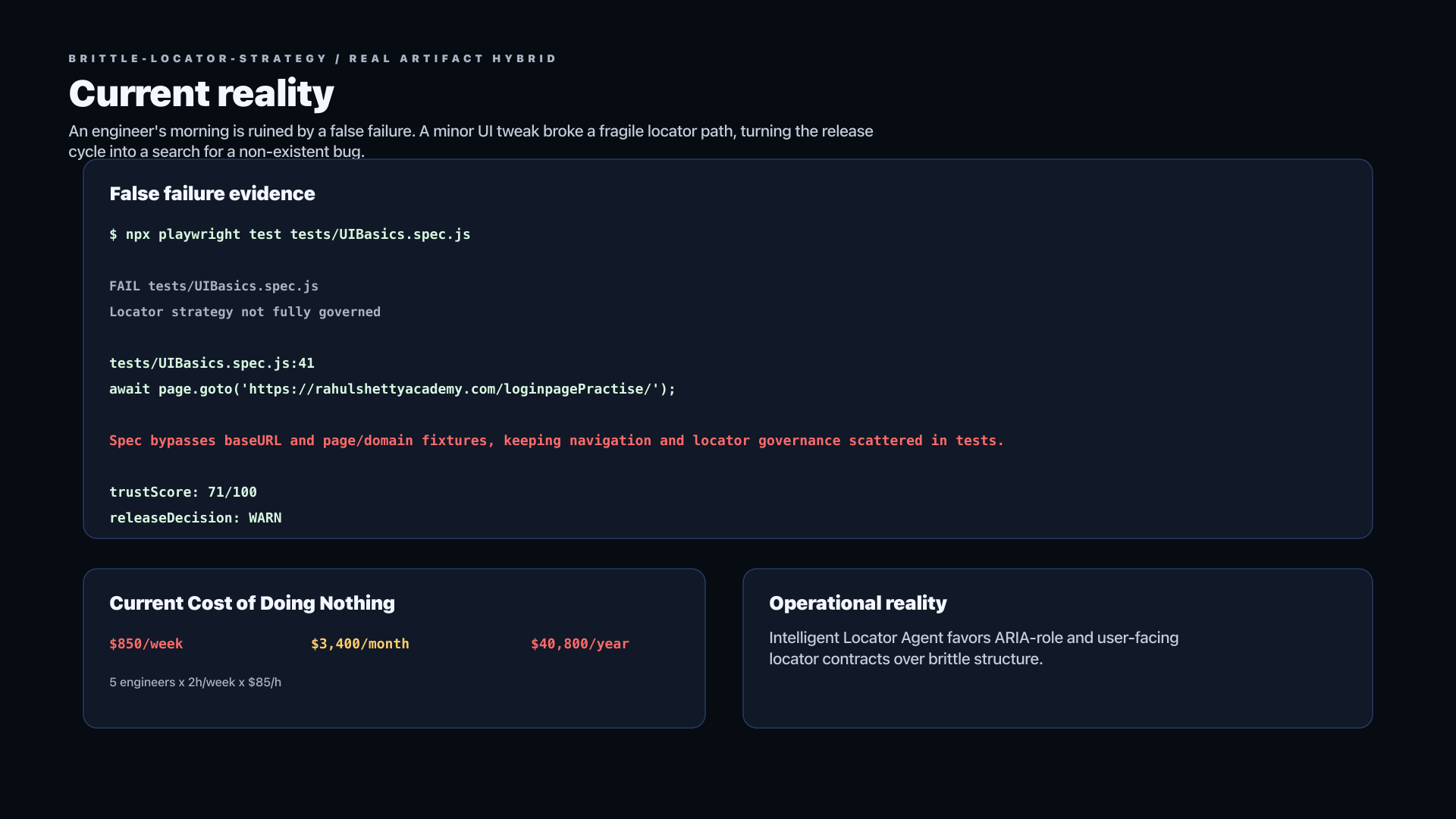
An engineer's morning is ruined by a false failure. A minor UI tweak broke a fragile locator path, turning the release cycle into a search for a non-existent bug.

Brittle Locator Strategy Client Assessment Story assessment evidence preview
What QA ALIGN found

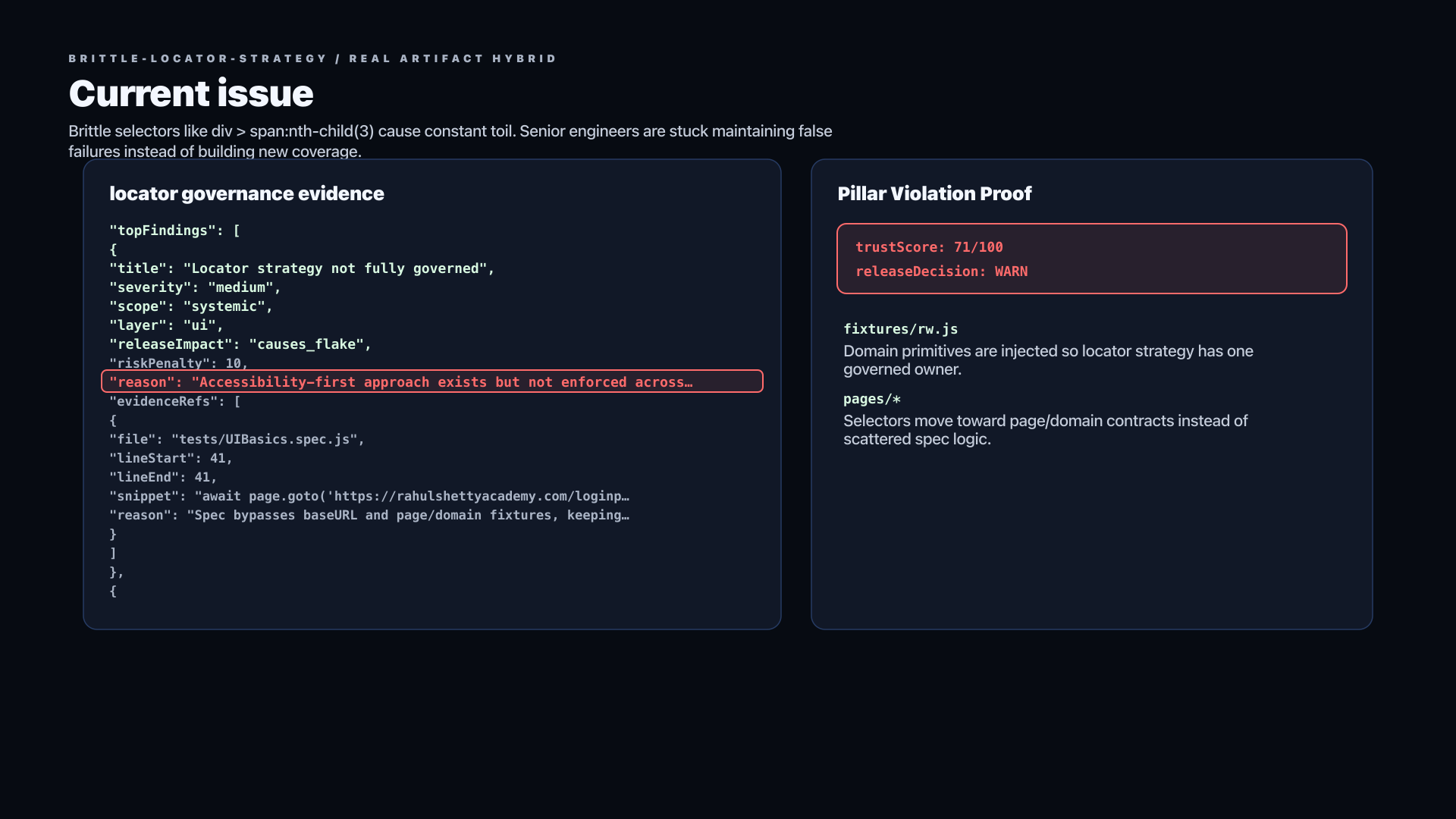
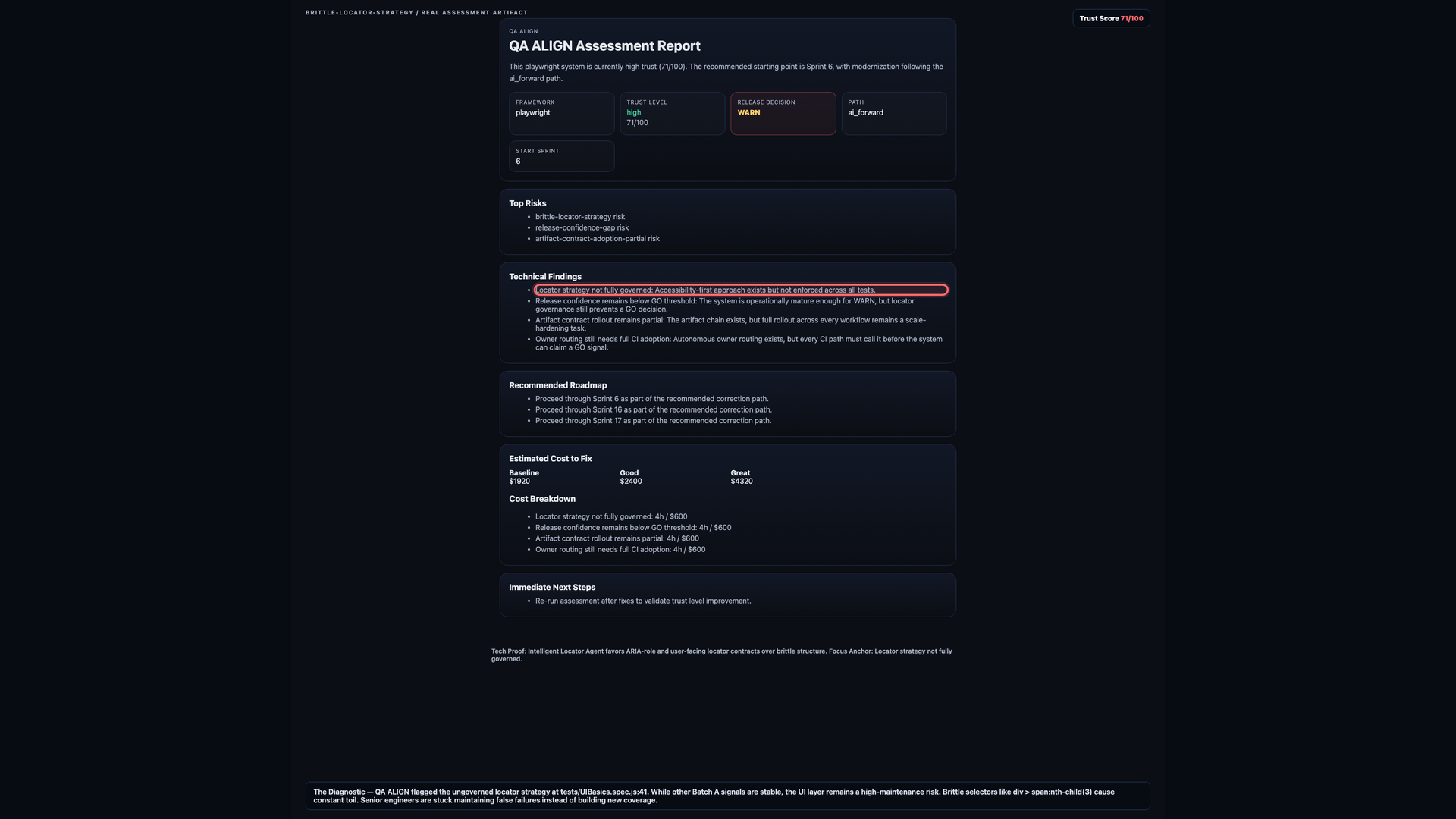
QA ALIGN flags the ungoverned locator strategy at tests/UIBasics.spec.js:41. While the Batch A foundations are stable, the UI layer remains a high-maintenance risk until selectors move behind ARIA-first page and domain contracts.

Evidence reviewed
  • Selector inventory
  • Affected page object or spec line numbers
  • Engineer fix report guardrails
  • Rerun locator trust result
Assessment decision

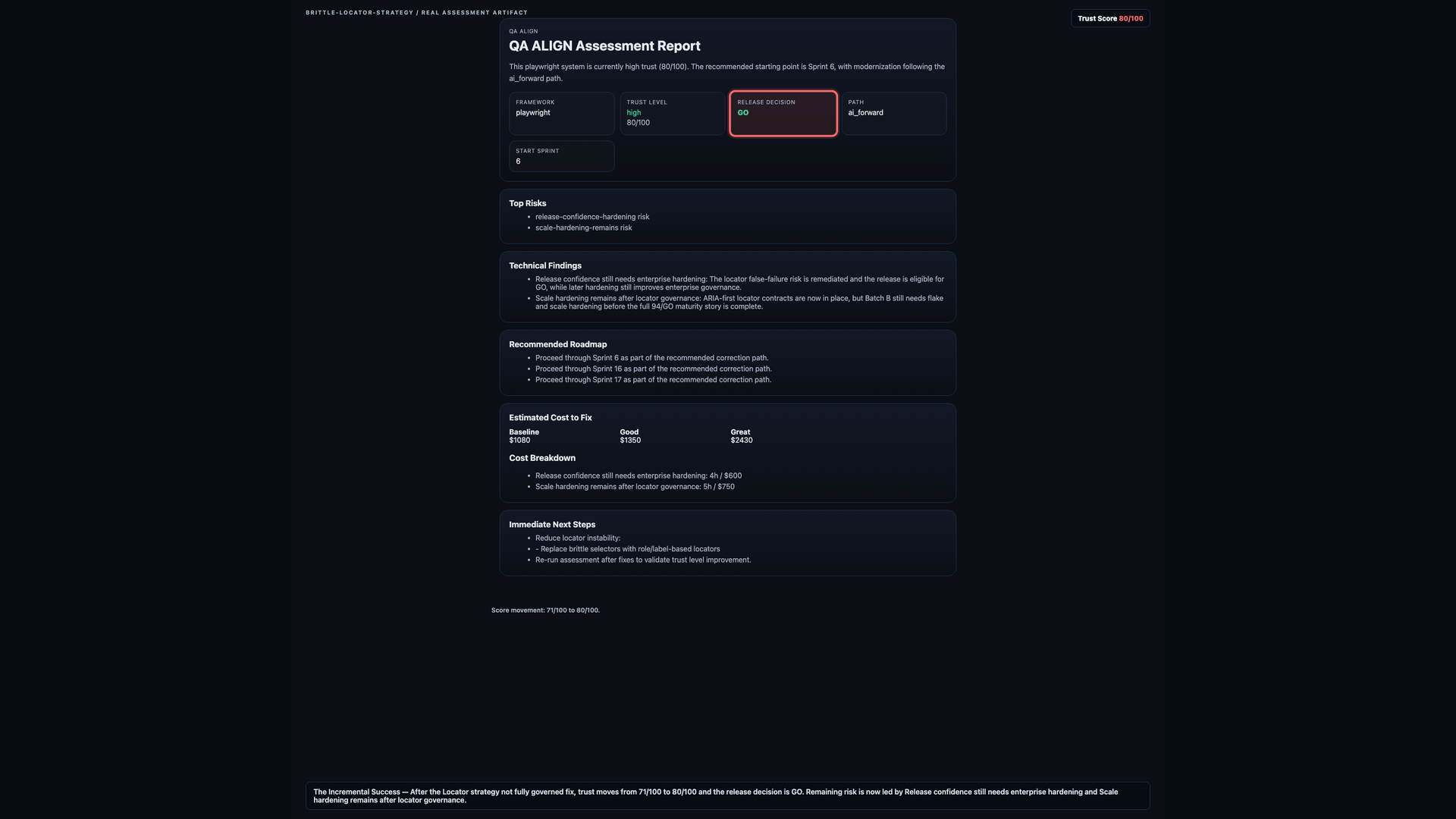
After locator governance is enforced, trust improves from 71 to 80 and the release moves to GO. UI risk remains visible, but false failures are now governed by user-facing contracts.

Brittle Locator Strategy proof

Four real snapshots from the Brittle Locator Strategy fix.

The evidence follows the real framework finding through assessment, engineering remediation, and a rerun showing trust improved from 71 to 80 while release is GO.

Brittle Locator Strategy raw issue evidence

1. The issue in JSON

The raw snapshot shows the false-failure pattern: locator ownership is not governed, so UI changes can break tests without proving product risk.

Brittle Locator Strategy assessment report naming the issue

2. How the report names it

The report names locator strategy as the implementation-quality risk while preserving the earned Batch A foundation score.

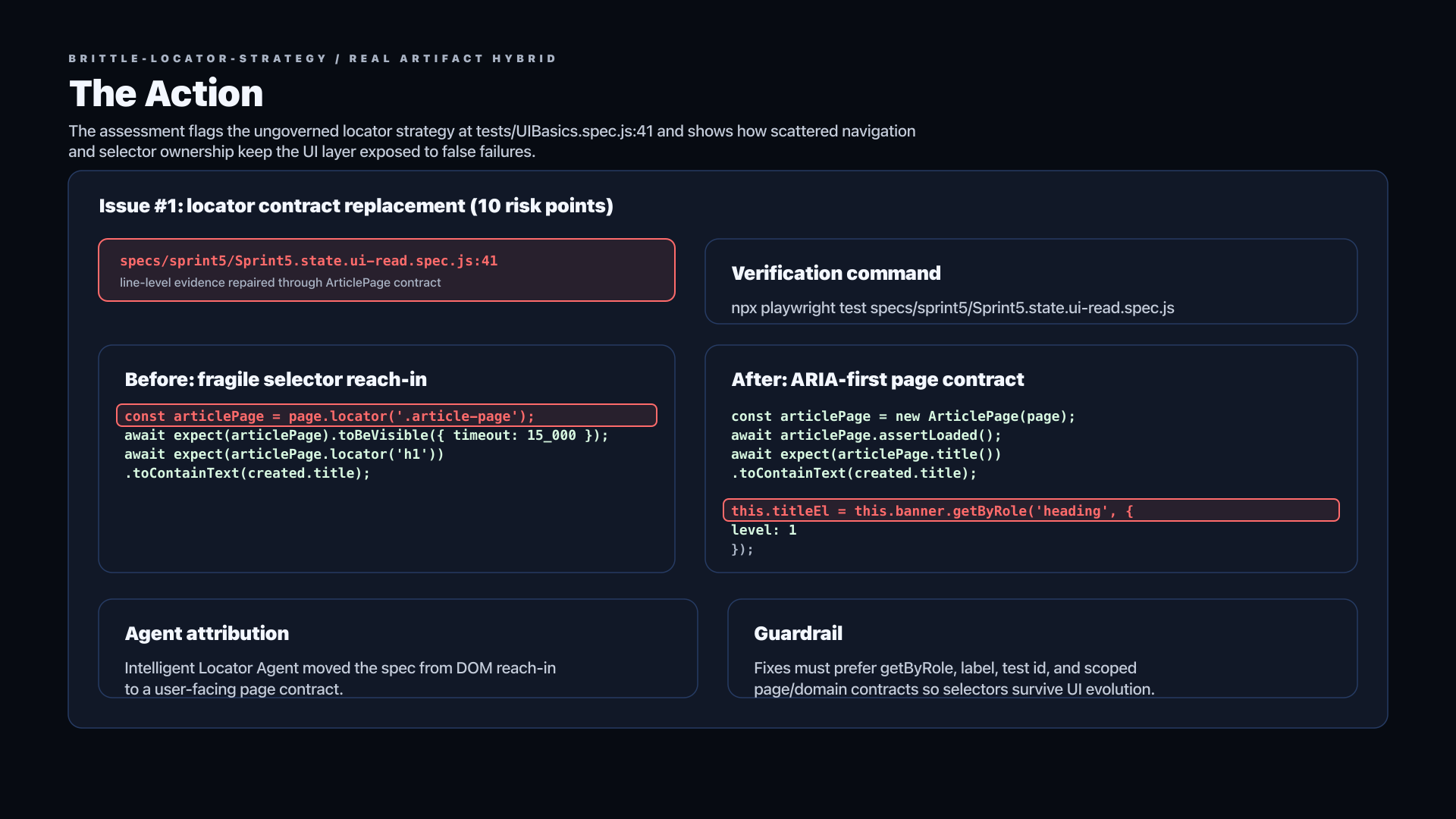
Brittle Locator Strategy engineer fix plan for the issue

3. What the fix plan says

The fix plan points the engineer toward ARIA-first and page-owned locator contracts instead of patching one brittle selector.

Brittle Locator Strategy rerun report after remediation

4. New report after rerun

A verified rerun measures the locator-risk reduction, updated trust level, and next implementation-quality risk.

Report outcomes

Know what is breaking trust before buying remediation

  • Know where locator strategy is weakening framework trust
  • See which selectors are highest risk to stabilize first
  • Understand where role, label, test id, or scoped locators should replace fragile selectors
  • Use locator-map, validation, and revalidation artifacts as engineering proof
  • Trace locator changes through a governed locator-trust workflow
  • Review weighted pricing for locator remediation
  • Give engineers a targeted internal fix plan after approval

Request the report

Only your email is required to begin. Add technical context only if it is useful.

Add optional context

Private intake. The external report is for your team. Internal engineer fix docs are not public-facing.