






Coverage Without Confidence

Find Out Why More Tests Are Not Creating More Trust

QA ALIGN compares discovered URL capabilities against existing automation coverage, then reports which critical flows, assertions, and evidence gaps still block release confidence.

External report for the client. Internal engineer fix document is created after approval to accelerate remediation.

Experienced improving systems for:

What QA ALIGN queries

Anti-patterns hiding inside the current framework

  • Large suites without clear risk or behavior mapping
  • Live URL capabilities exist but are not represented in the automated test plan
  • Coverage gaps hide silent regression zones in critical user flows
  • Duplicated checks that increase runtime without increasing confidence
  • Critical journeys missing evidence-rich validation
  • Field-heavy flows lack a field catalog or data-driven input plan
  • Assertions verify surface behavior but miss decision-critical state
  • Coverage reports are not connected to release risk
What the client receives

An external report with issues, trust level, and prices

  • Detected framework anti-patterns with affected areas
  • Current framework trust level
  • Issue evidence and severity
  • Weighted prices to fix the recommended changes
  • Recommended first remediation path

Sample finding

Live capabilities are missing from the automated safety net

More tests can create more noise if they do not map to the product behavior users actually rely on. QA ALIGN compares discovered URL capabilities against the current suite to show which flows are protected, duplicated, or missing.

Detected anti-pattern

The report prices fixes that improve confidence quality, not just suite size, and gives engineers a coverage gap map they can turn into targeted test work.

Current assessment scenario

Coverage Without Confidence Client Assessment Story

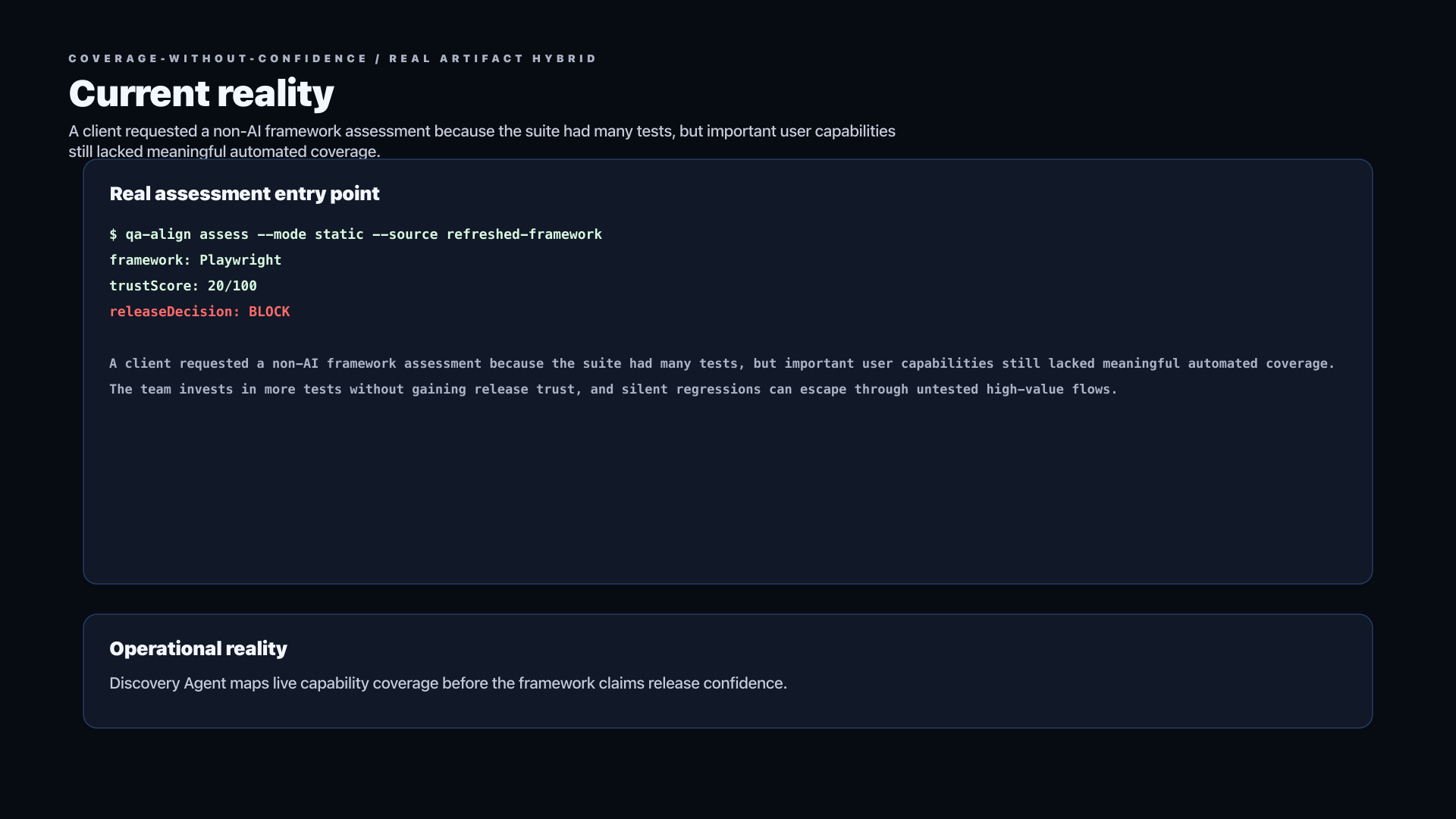
A client requested a non-AI framework assessment because the suite had many tests, but important user capabilities still lacked meaningful automated coverage.

Coverage Without Confidence Client Assessment Story assessment evidence preview
What QA ALIGN found

QA ALIGN found gaps between live product capability, route discovery, and existing automated checks. The assessment produces an engineer fix report with affected routes, specs, coverage maps, and line-level targets for adding or strengthening the checks that matter.

Evidence reviewed
  • Discovered route/capability map
  • Existing spec coverage map
  • Affected coverage/spec line numbers
  • Rerun coverage confidence result
Assessment decision

After the engineer implements the fix and reruns the framework assessment, the coverage gaps behind high test volume that caused the BLOCK is cleared, trust level moves to high, and the release decision becomes GO.

Coverage Without Confidence proof

Four aligned snapshots from the Coverage Without Confidence story.

The available evidence maps live routes, critical flows, and capability gaps without mixing in findings from unrelated risks.

Coverage Without Confidence current reality showing missing meaningful automated coverage

1. The coverage gap

The aligned scenario shows the real assessment entry point: many tests exist, but important user capabilities still lack meaningful automated coverage.

Coverage Without Confidence visual operating system card

2. What the signal means

The Coverage pillar is about confidence quality: live routes, critical flows, and capability gaps need to be mapped before more tests can create more trust.

Coverage Without Confidence assessment evidence for the targeted coverage fix path

3. What the fix path targets

The fix path is targeted coverage work: connect discovered routes and high-value flows to stronger checks instead of adding broad, low-signal tests.

Coverage Without Confidence proof status visual

4. Proof status

Current evidence confirms the coverage gap; a Coverage-specific assessment and fix plan are still required before claiming remediation.

Report outcomes

Know what is breaking trust before buying remediation

  • Compare discovered URL capabilities against current automation coverage
  • See which high-value flows are missing, duplicated, or weakly asserted
  • Use a deterministic URL-to-Test Plan and Coverage Gap Map as proof
  • Include a Field Catalog CSV when discovered forms need data-driven coverage
  • Review weighted pricing for coverage-quality fixes
  • Give engineers a faster internal plan for accepted improvements

Request the report

Only your email is required to begin. Add technical context only if it is useful.

Add optional context

Private intake. The external report is for your team. Internal engineer fix docs are not public-facing.