






Flaky Test Instability

Find the System Patterns Behind Flaky Tests

Get a trust report that identifies the framework anti-patterns causing intermittent failures, unstable suites, and low confidence in automation results.

External report for the client. Internal engineer fix document is created after approval to accelerate remediation.

Experienced improving systems for:

What QA ALIGN queries

Anti-patterns hiding inside the current framework

  • Order-dependent tests that pass alone and fail in suite execution
  • Shared state that is not reset before each scenario
  • Wait logic that masks timing races instead of removing them
  • Assertions that depend on unstable UI, data, or external services
  • Flake categories that are not separated for pricing or remediation
What the client receives

An external report with issues, trust level, and prices

  • Detected framework anti-patterns with affected areas
  • Current framework trust level
  • Issue evidence and severity
  • Weighted prices to fix the recommended changes
  • Recommended first remediation path

Sample finding

Flake fixes are happening one test at a time

When the same failure shapes repeat across the suite, isolated test edits only hide the system pattern. QA ALIGN checks whether the framework has controls that prevent those patterns from returning.

Detected anti-pattern

Current framework trust stays low when flakes are patched manually. The report prices the framework fixes needed to make stability repeatable.

Current assessment scenario

Flaky Test Instability Client Assessment Story

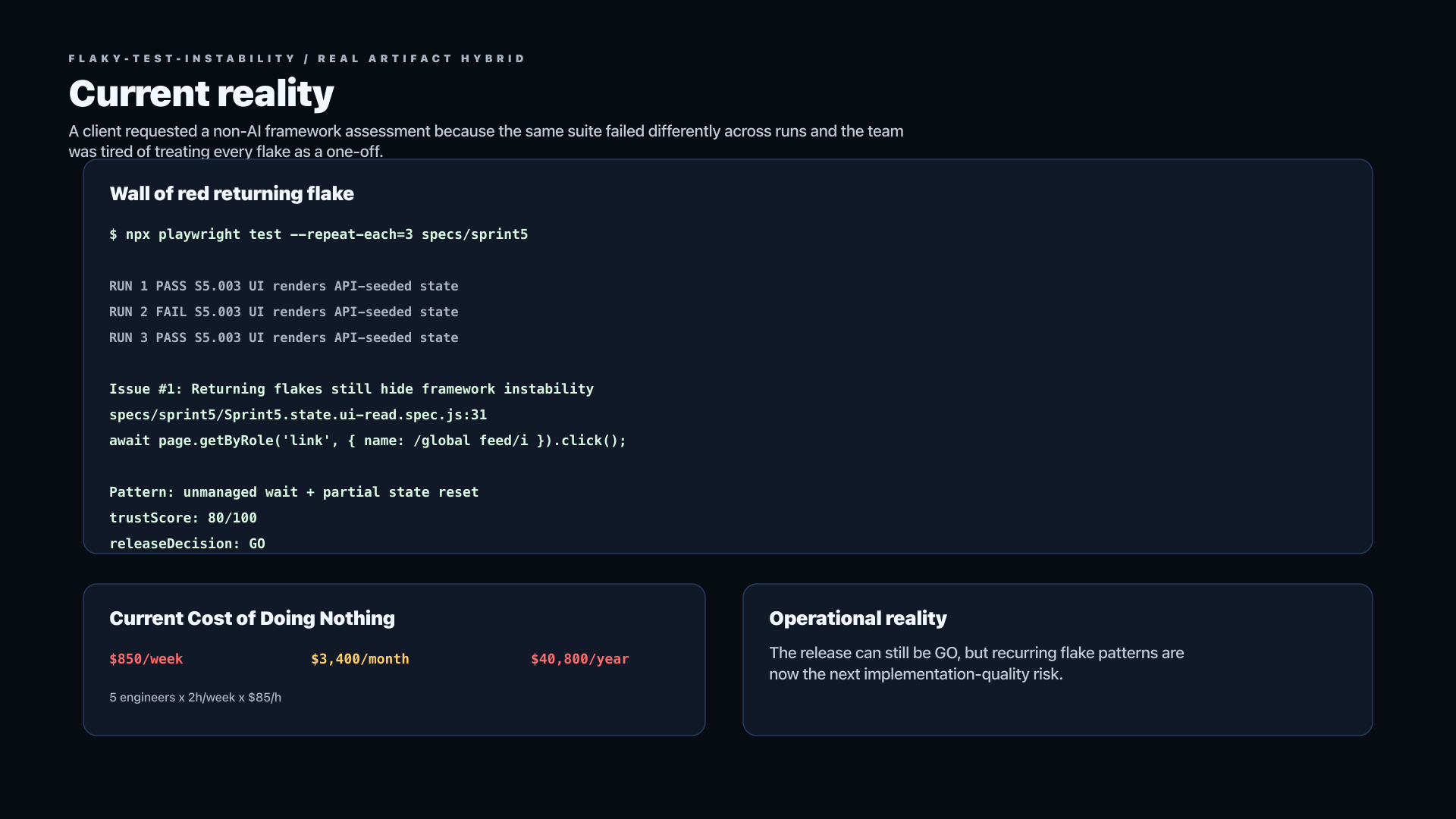
A client requested a non-AI framework assessment because the same suite failed differently across runs and the team was tired of treating every flake as a one-off.

Flaky Test Instability Client Assessment Story assessment evidence preview
What QA ALIGN found

QA ALIGN found repeatable instability patterns across timing, state, locator, data, and environment behavior. The assessment produces an engineer fix report with affected specs, helpers, fixture files, and line-level stabilization targets grouped by root-cause pattern.

Evidence reviewed
  • Run history
  • Affected specs and helpers
  • Line-level flake pattern findings
  • Rerun stability result
Assessment decision

After the engineer implements the fix and reruns the framework assessment, the systemic flaky test instability that caused the BLOCK is cleared, trust level moves to high, and the release decision becomes GO.

Flaky Test Instability proof

Four real snapshots from the Flaky Test Instability fix.

The evidence follows the real framework finding through assessment, engineering remediation, and a rerun showing trust improved from 80 to 88 while release is GO.

Flaky Test Instability raw issue evidence

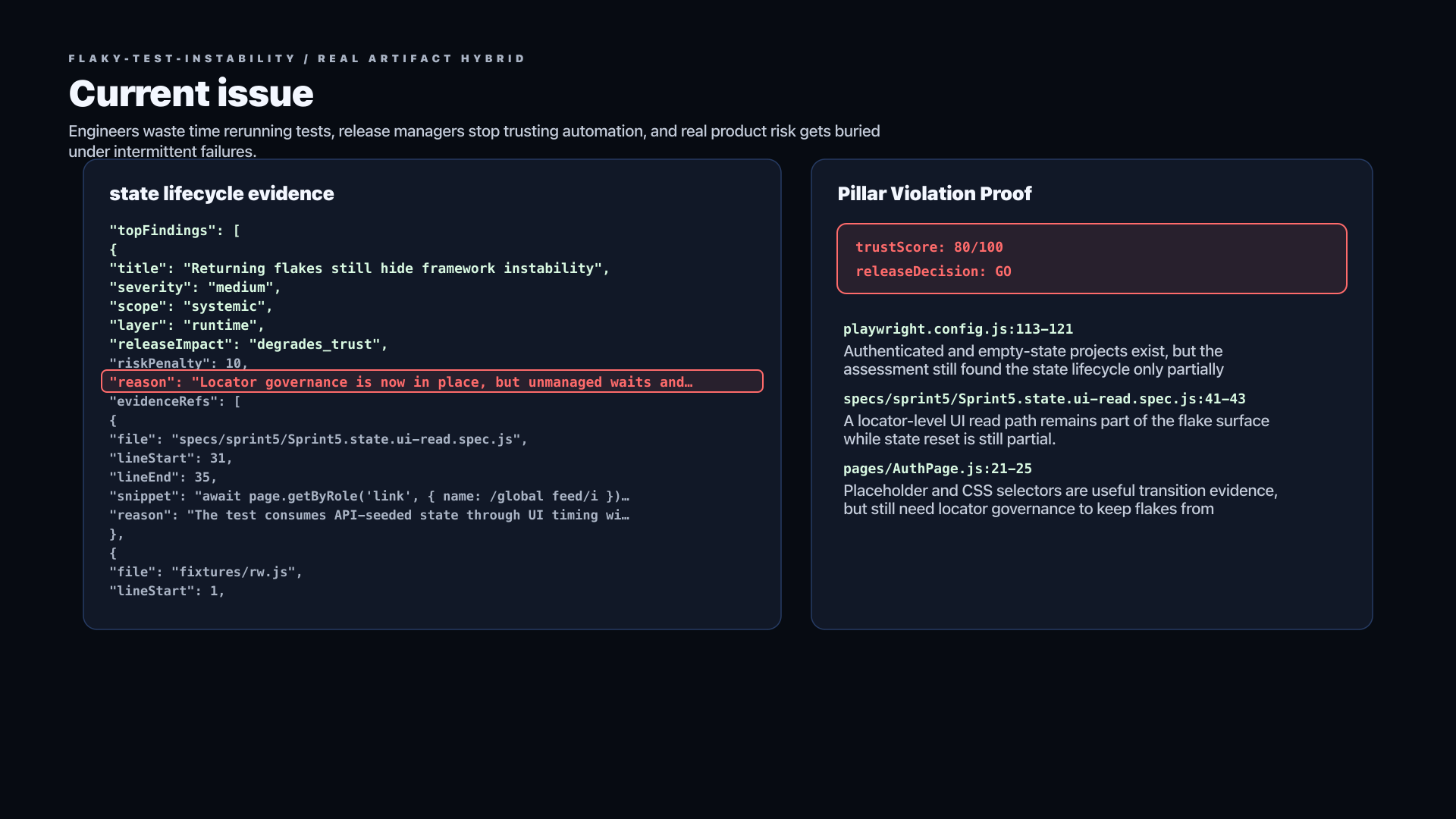
1. The issue in JSON

The raw snapshot shows the returning-flake pattern: a test can pass, fail, and pass again because the framework is still leaning on unstable contracts.

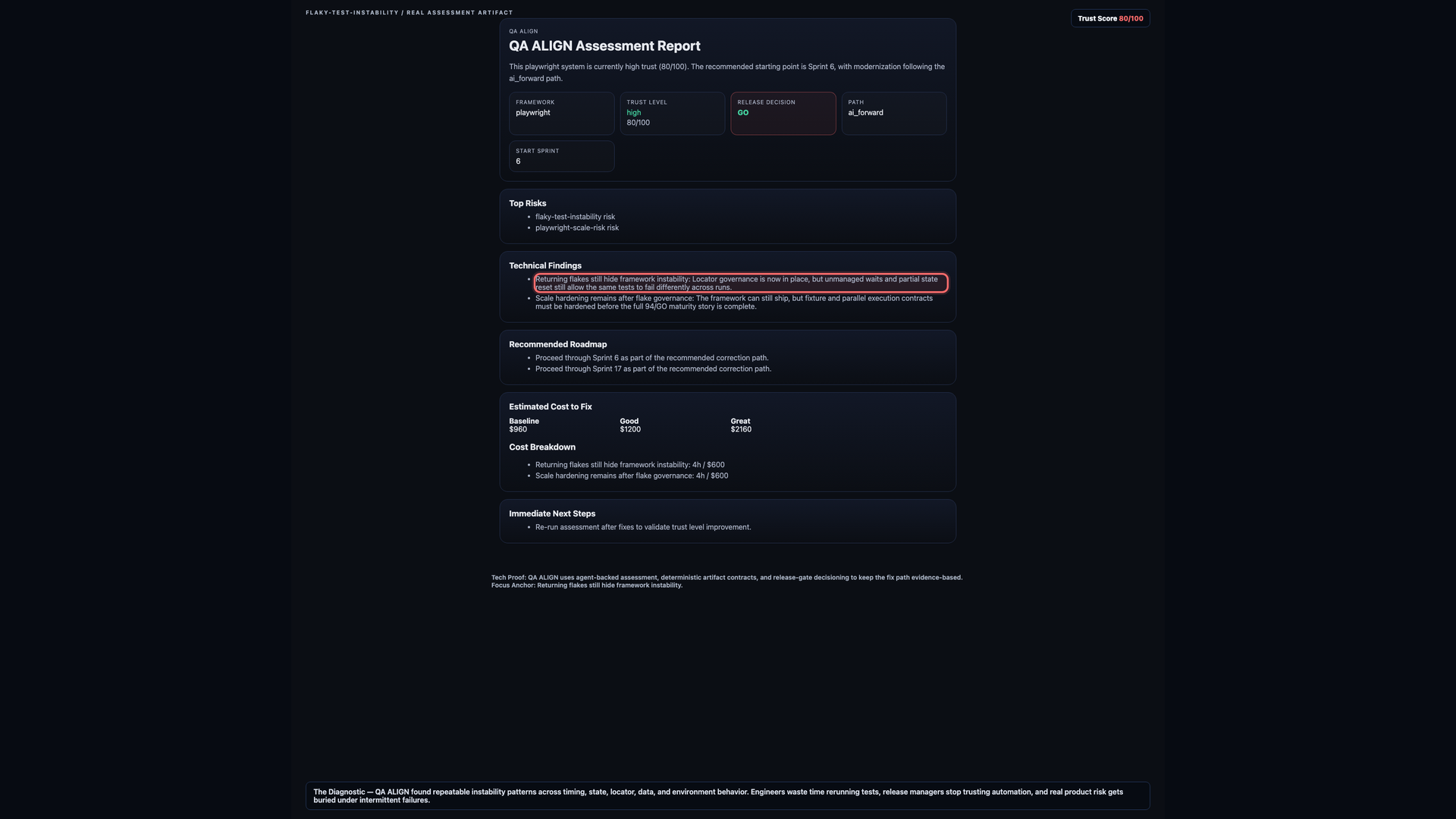
Flaky Test Instability assessment report naming the issue

2. How the report names it

The report names the system pattern behind the flake instead of treating one red run as an isolated test failure.

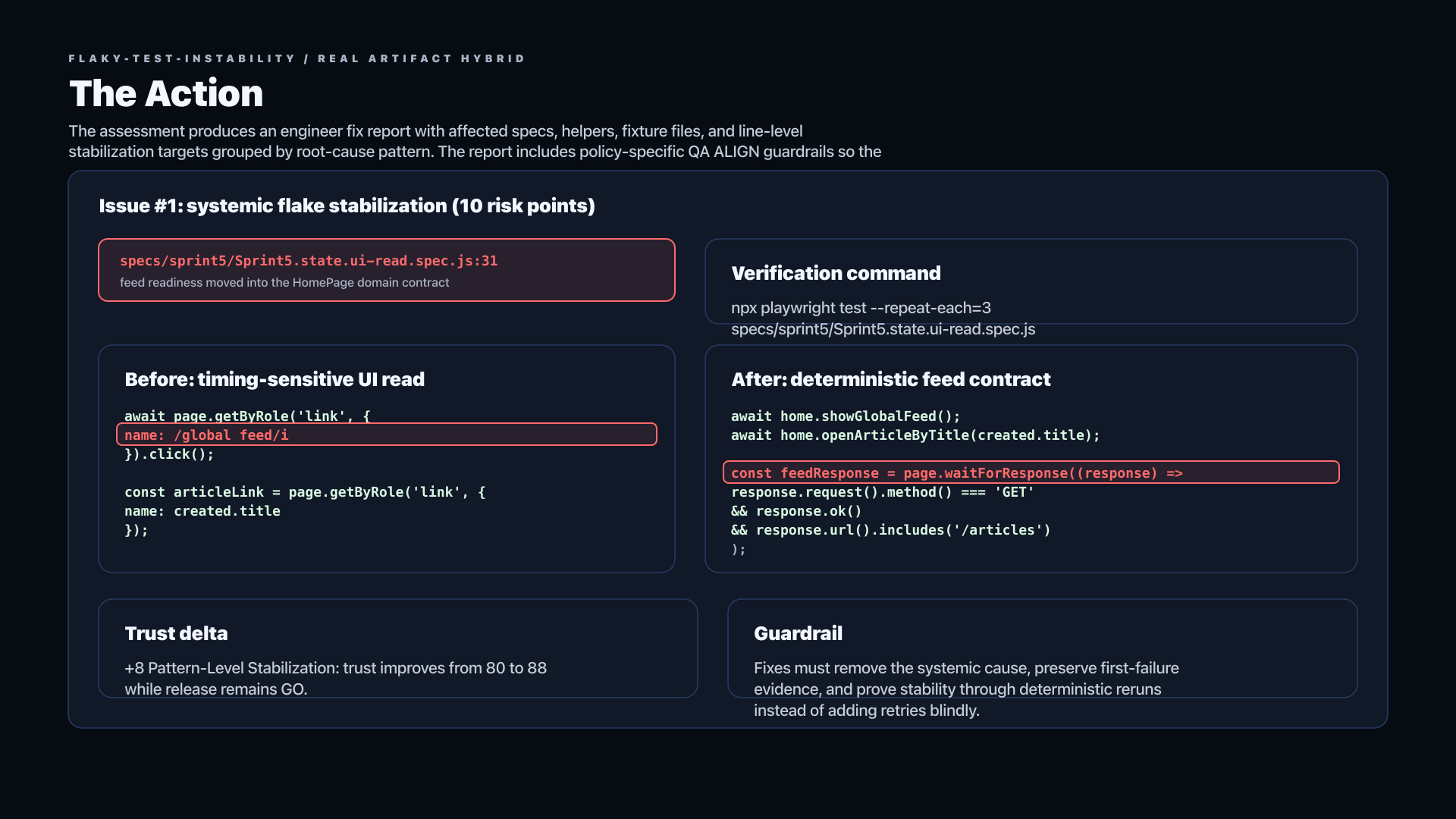
Flaky Test Instability engineer fix plan for the issue

3. What the fix plan says

The fix plan moves the repair to the framework level, replacing timing-sensitive behavior with deterministic readiness and state contracts.

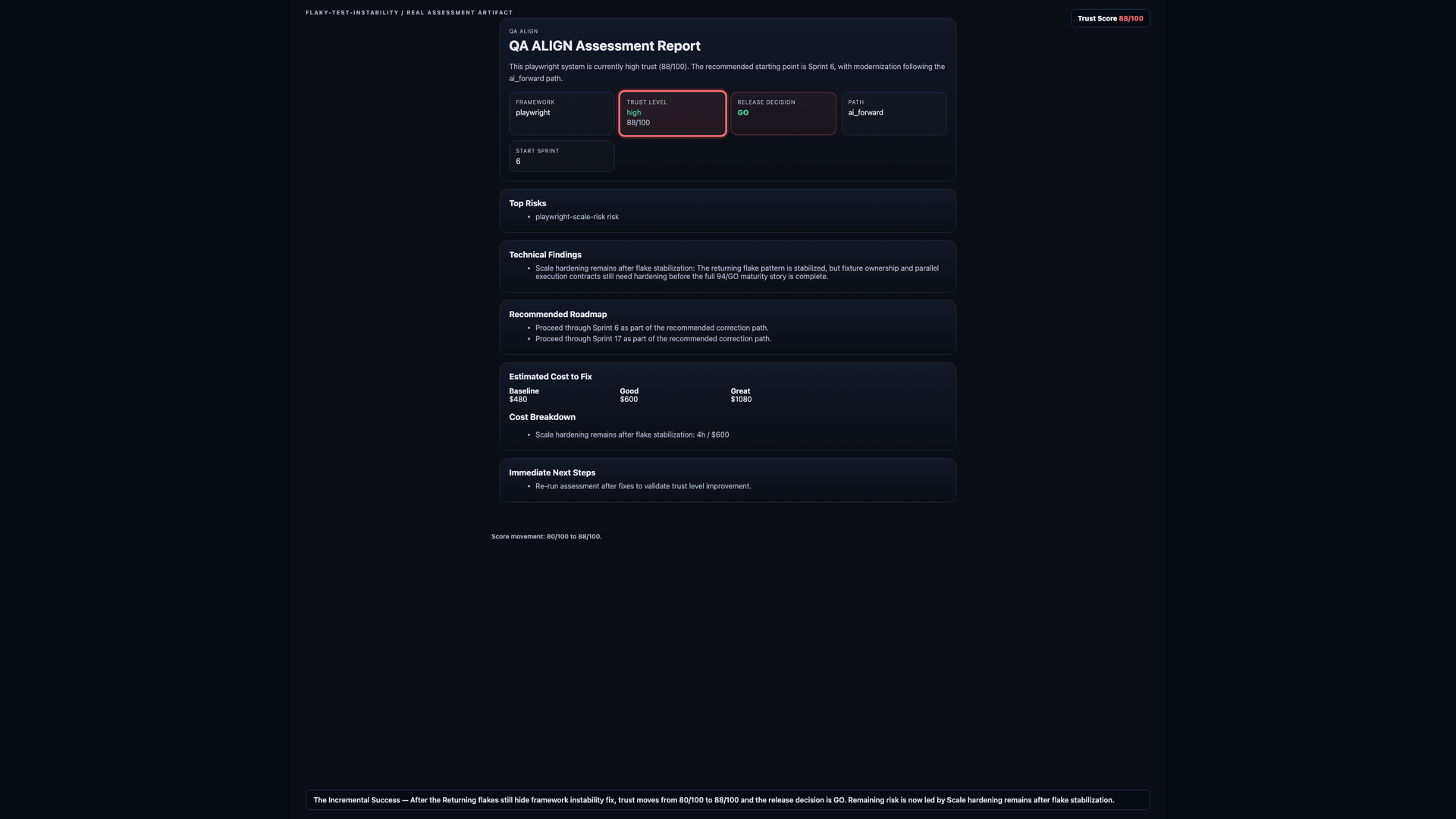
Flaky Test Instability rerun report after remediation

4. New report after rerun

A verified rerun measures whether the flake source is removed and identifies Playwright scale risk as the next priority.

Report outcomes

Know what is breaking trust before buying remediation

  • See which flake patterns are framework-level instead of test-level
  • Separate timing, state, data, locator, and environment causes
  • Understand which fixes raise trust fastest
  • Review weighted pricing before approving remediation
  • Give engineers an internal fix document for accepted changes

Request the report

Only your email is required to begin. Add technical context only if it is useful.

Add optional context

Private intake. The external report is for your team. Internal engineer fix docs are not public-facing.