Noisy CI Signals

Stop Rerunning CI Failures That Cannot Explain Themselves

QA ALIGN queries your automation framework for anti-patterns, then returns an external report showing detected issues, current framework trust level, and prices to fix.

External report for the client. Internal engineer fix document is created after approval to accelerate remediation.

Experienced improving systems for:

What QA ALIGN queries

Anti-patterns hiding inside the current framework

  • Failures that require reruns before anyone can diagnose them
  • Missing or inconsistent trace, screenshot, video, console, and log artifacts
  • CI-only failures caused by environment drift or hidden dependencies
  • Test output that cannot support a GO / WARN / BLOCK release decision
  • Failure categories that are not separated by assertion, data, timing, state, and environment

What the client receives

An external report with issues, trust level, and prices

  • Detected framework anti-patterns with affected areas
  • Current framework trust level
  • Issue evidence and severity
  • Weighted prices to fix the recommended changes
  • Recommended first remediation path

Sample finding

Reruns are acting as the diagnosis layer

When CI failures only become understandable after reruns, the framework is not producing a release-ready signal. QA ALIGN checks whether the first failure contains enough evidence to classify the issue.

Detected anti-pattern

Current framework trust stays low when failures cannot explain themselves from preserved artifacts. The report prices the fixes needed to make first-run diagnosis reliable.

Current assessment scenario

Noisy CI Signals Client Assessment Story

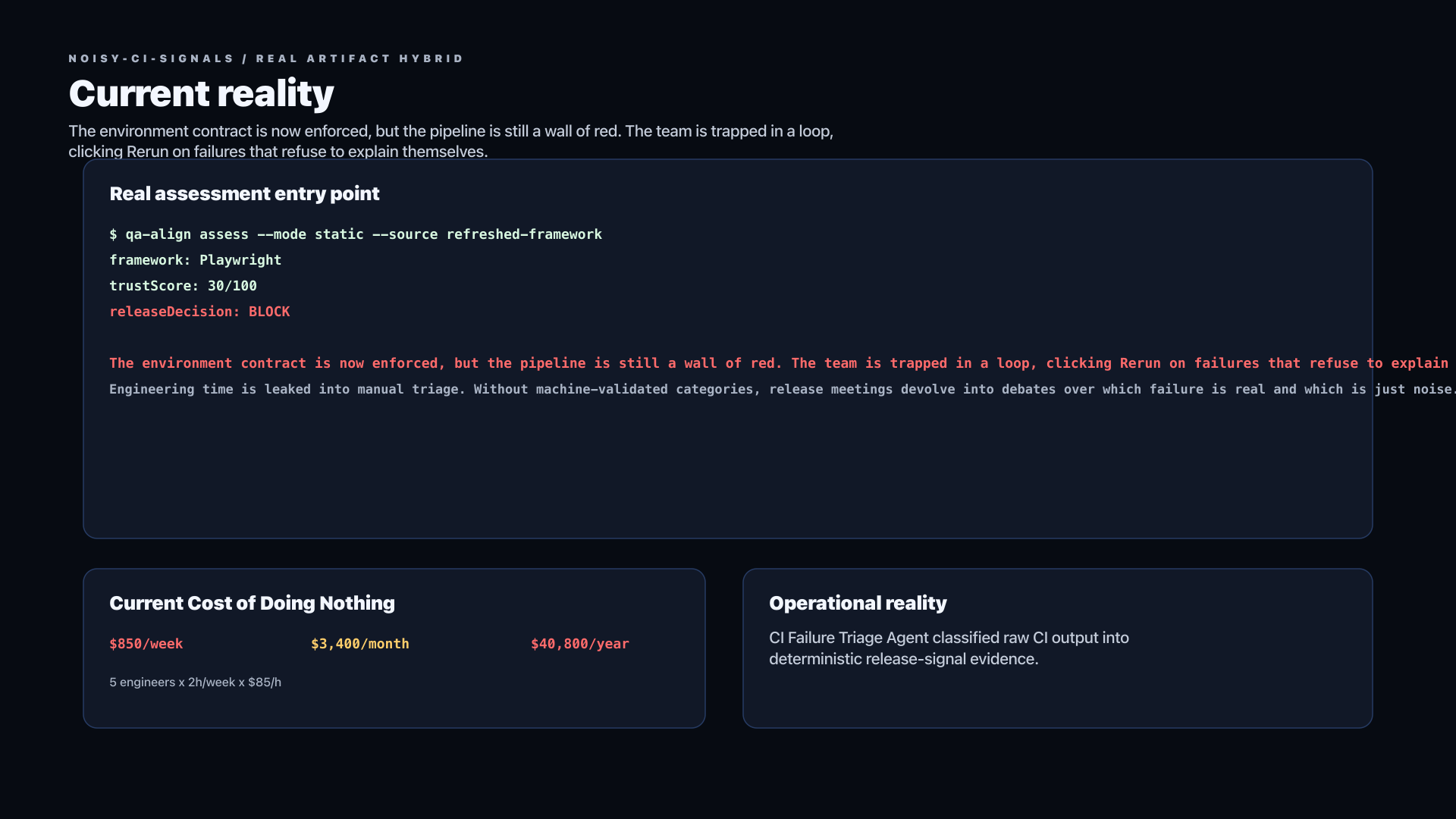
The environment contract is now enforced, but the pipeline is still a wall of red. The team is trapped in a loop, clicking Rerun on failures that refuse to explain themselves.

Noisy CI Signals Client Assessment Story assessment evidence preview
What QA ALIGN found

The assessment identifies the bottleneck: Ambiguous Signal Handling. Artifacts exist, but without classification, every failure is treated as a release blocker by default.

Evidence reviewed
  • CI run metadata
  • Failure contract JSON
  • Engineer fix report with affected CI files and line numbers
  • Rerun release decision
Assessment decision

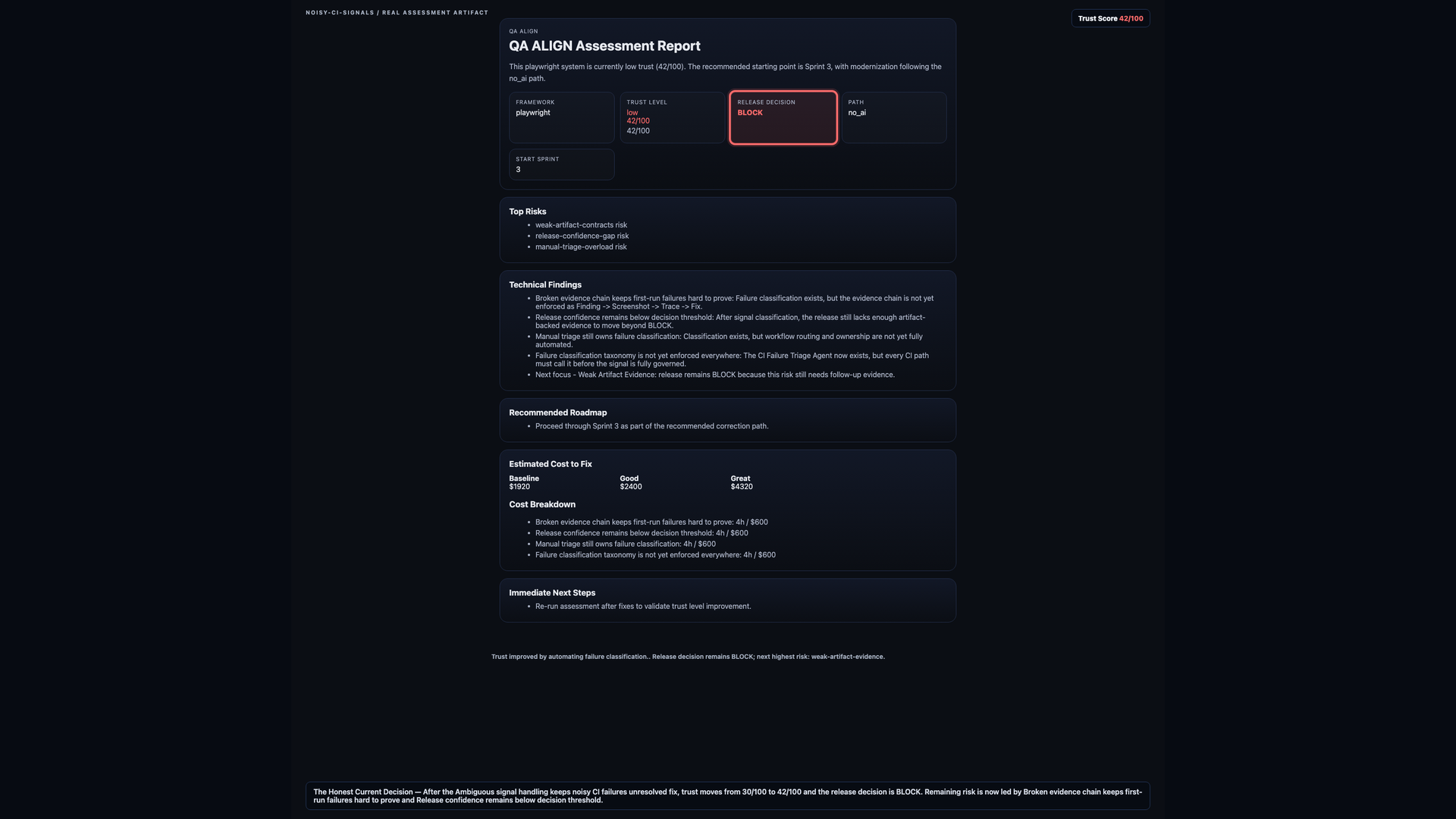
Trust improved from 30 to 42. The signal is clearer, but the release remains BLOCK because remaining risks still exist. The next step in the maturity journey is weak artifact evidence.

Rerun culture proof

Four real snapshots from the Noisy CI rerun fix.

The evidence follows the issue from raw JSON through assessment, engineering remediation, and a rerun that improves trust to 42 while release stays BLOCK.

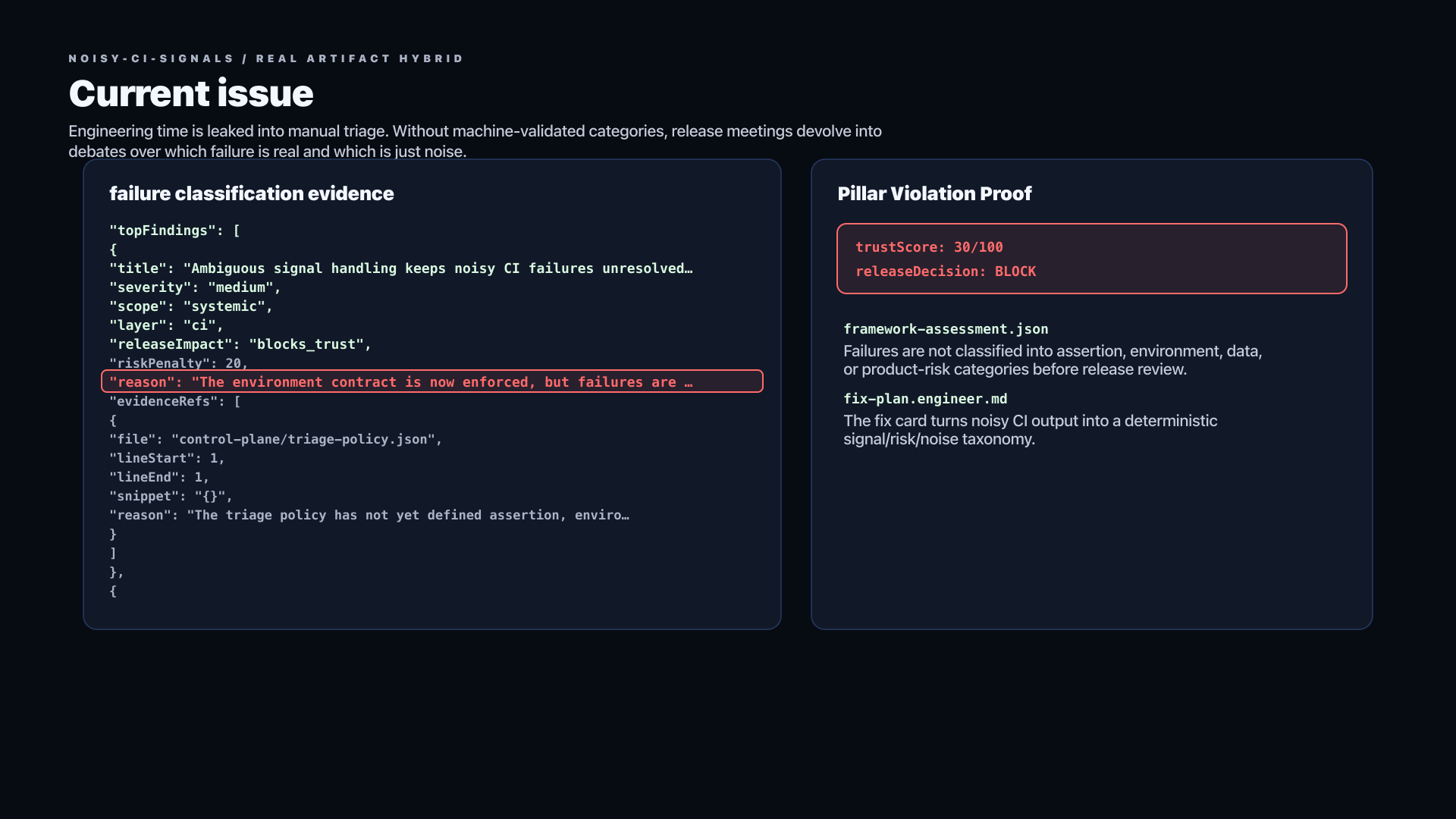
Noisy CI raw JSON issue showing ambiguous signal handling before classification

1. The issue in JSON

The baseline snapshot shows the top finding: ambiguous signal handling keeps noisy CI failures unresolved, with control-plane/triage-policy.json still empty.

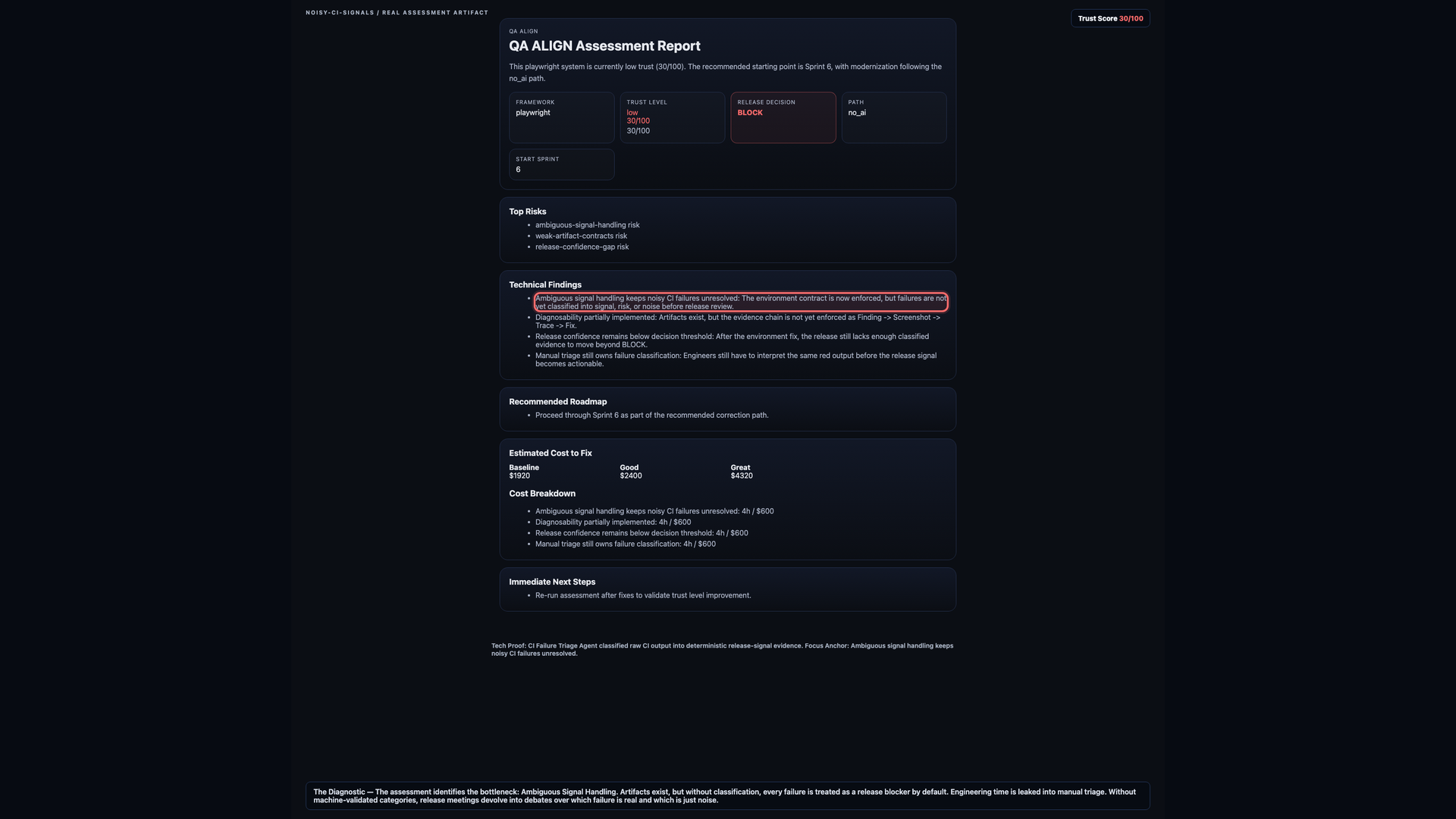
QA ALIGN report showing ambiguous signal handling as the Noisy CI finding

2. How the report names it

The client report highlights 30/100 BLOCK and calls out that failures are not yet classified into signal, risk, or noise before release review.

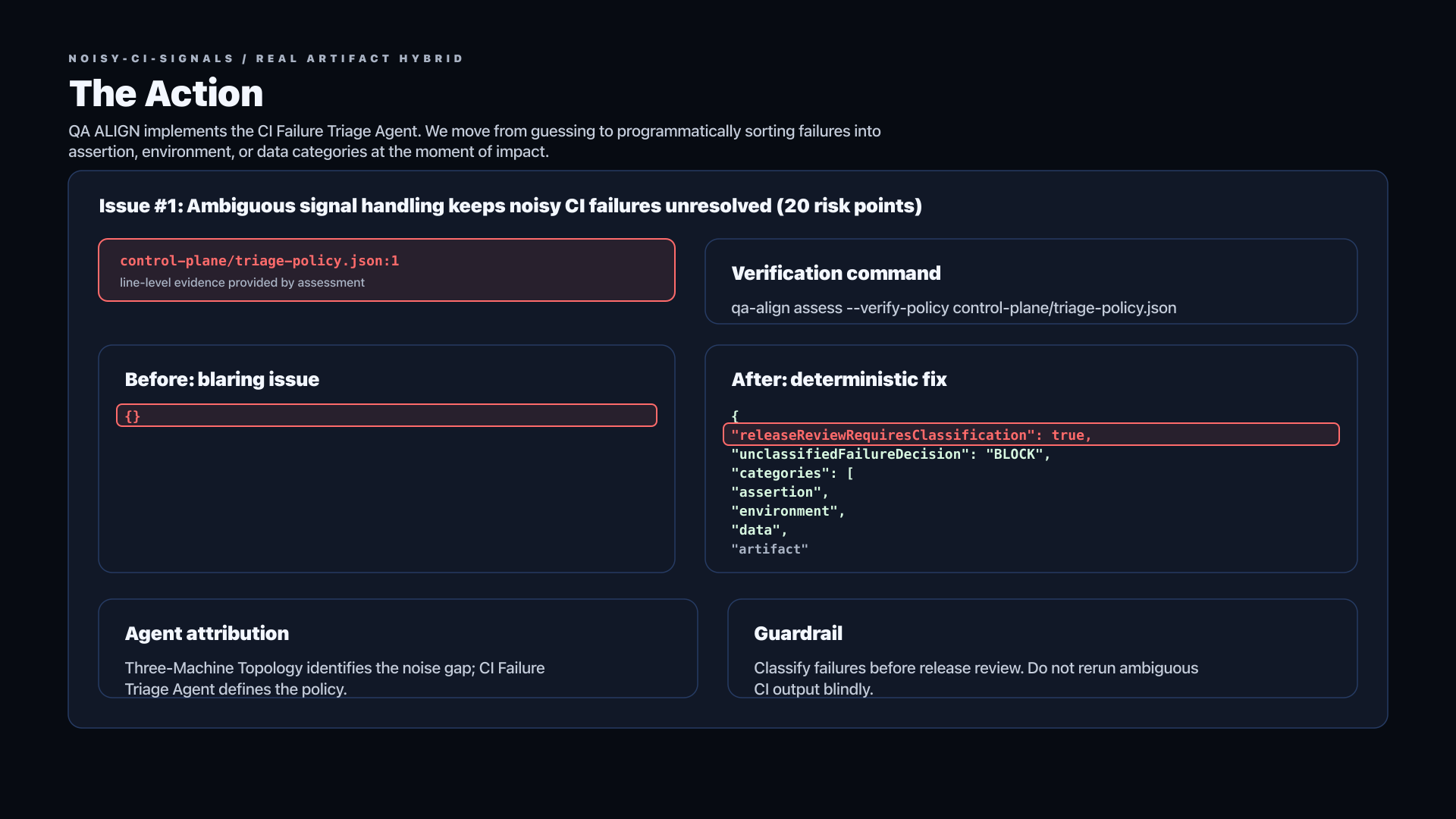
Engineer fix plan targeting control-plane triage policy for failure classification

3. What the fix plan says

The engineer plan targets control-plane/triage-policy.json:1 and replaces the empty policy with assertion, environment, data, and artifact classifications.

Noisy CI rerun report showing trust score improved to 42 while release remains BLOCK

4. New report after rerun

After the classifier is implemented, the rerun report shows trust improved from 30 to 42. Release remains BLOCK because weak-artifact evidence is now the next highest risk.


Report outcomes

Know what is breaking trust before buying remediation

  • Know whether CI signal is trustworthy enough for release decisions
  • See which anti-patterns are creating noisy or ambiguous failures
  • Understand what needs to change before the framework can be trusted
  • Review pricing before approving remediation
  • Give engineers a faster internal fix path after approval

Request the report

Only your email is required to begin. Add technical context only if it is useful.

Add optional context

Private intake. The external report is for your team. Internal engineer fix docs are not public-facing.