






Order Dependence

Identify the Hidden Sequence Risks in Your Test Suite

QA ALIGN maps run-order, setup, teardown, shared data, and state leakage evidence so hidden sequence dependencies can be removed before they distort release signals.

External report for the client. Internal engineer fix document is created after approval to accelerate remediation.

Experienced improving systems for:

What QA ALIGN queries

Anti-patterns hiding inside the current framework

  • Tests pass in isolation but fail when run after other scenarios
  • Setup and cleanup routines depend on prior suite state
  • Shared accounts, records, sessions, or services leak between tests
  • Parallel execution exposes hidden collisions
  • Reports do not distinguish sequence risk from product defects
  • Retry or rerun behavior hides the order-dependent failure pattern
What the client receives

An external report with issues, trust level, and prices

  • Detected framework anti-patterns with affected areas
  • Current framework trust level
  • Issue evidence and severity
  • Weighted prices to fix the recommended changes
  • Recommended first remediation path

Sample finding

Suite order is hiding the real failure pattern

When the same test passes alone and fails in suite execution, the framework is measuring sequence pollution instead of product risk. QA ALIGN checks whether tests control the state they require and whether suite order changes the result.

Detected anti-pattern

The report prices the isolation, reset, and setup fixes needed to make suite results repeatable, parallel-safe, and release-credible.

Current assessment scenario

Order Dependence Client Assessment Story

Your automation has a lucky order. If you shuffle the tests, the whole suite collapses.

Order Dependence Client Assessment Story assessment evidence preview
What QA ALIGN found

QA ALIGN found sequence-dependent failure evidence in the real validation output and localStorage-backed setup assertions. The assessment produces an engineer fix report targeting fixtures/rw.js and modular business-flow ownership.

Evidence reviewed
  • Run-order failure evidence
  • LocalStorage-backed setup assertions
  • Affected spec and fixture line numbers
  • Repeated-worker verification target
Assessment decision

The current assessed state is 50/100 BLOCK. WARN or GO requires a completed fixture-owned business-flow repair and a verified framework reassessment.

Order Dependence proof

Four real snapshots from the Order Dependence fix.

The evidence connects the raw issue, assessment report, engineer fix plan, and rerun result.

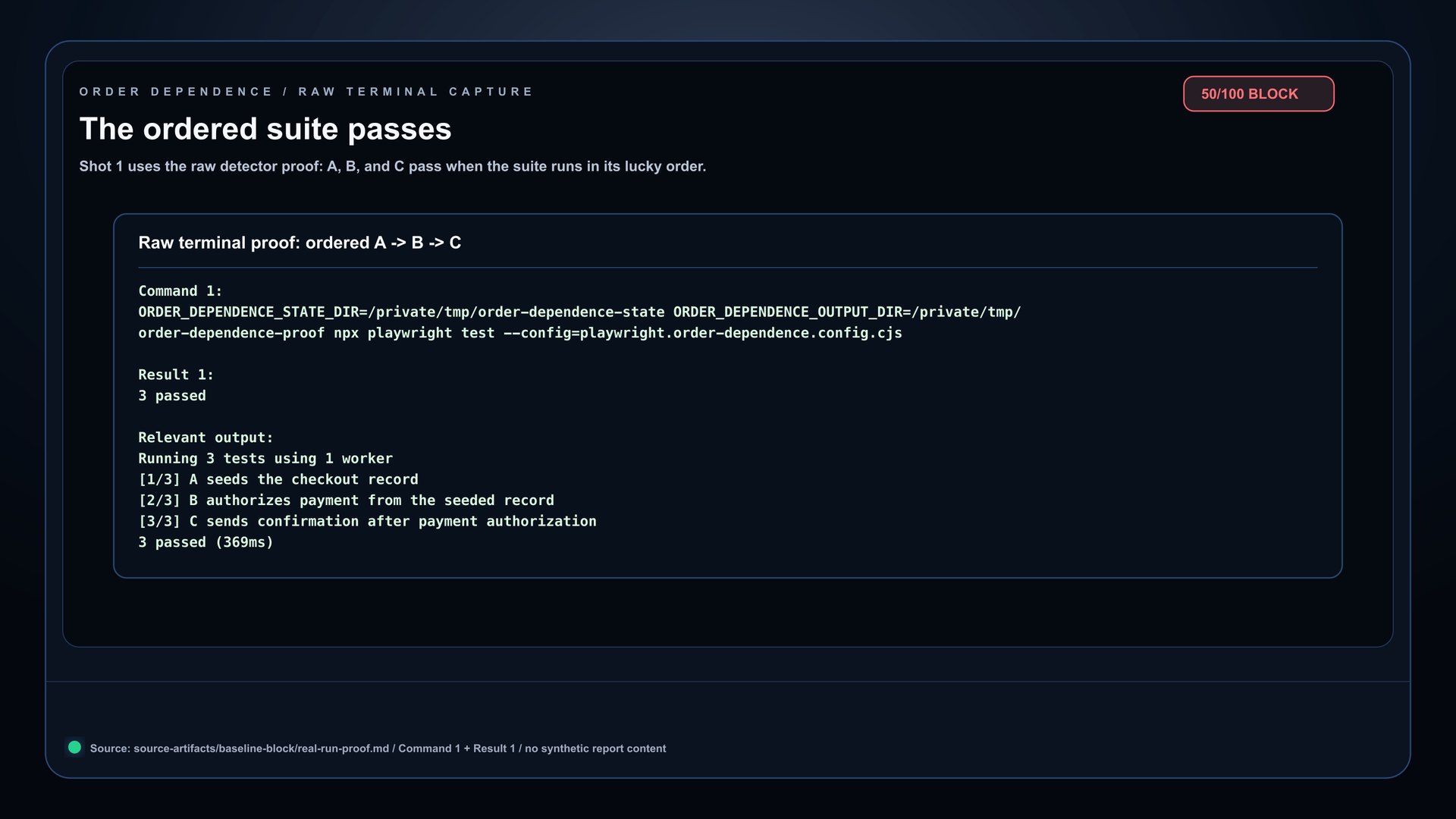
Order Dependence current reality showing lucky-order sequence risk

1. The lucky-order run

The real validation output flags reliance on test order and connects the finding to the observed execution sequence.

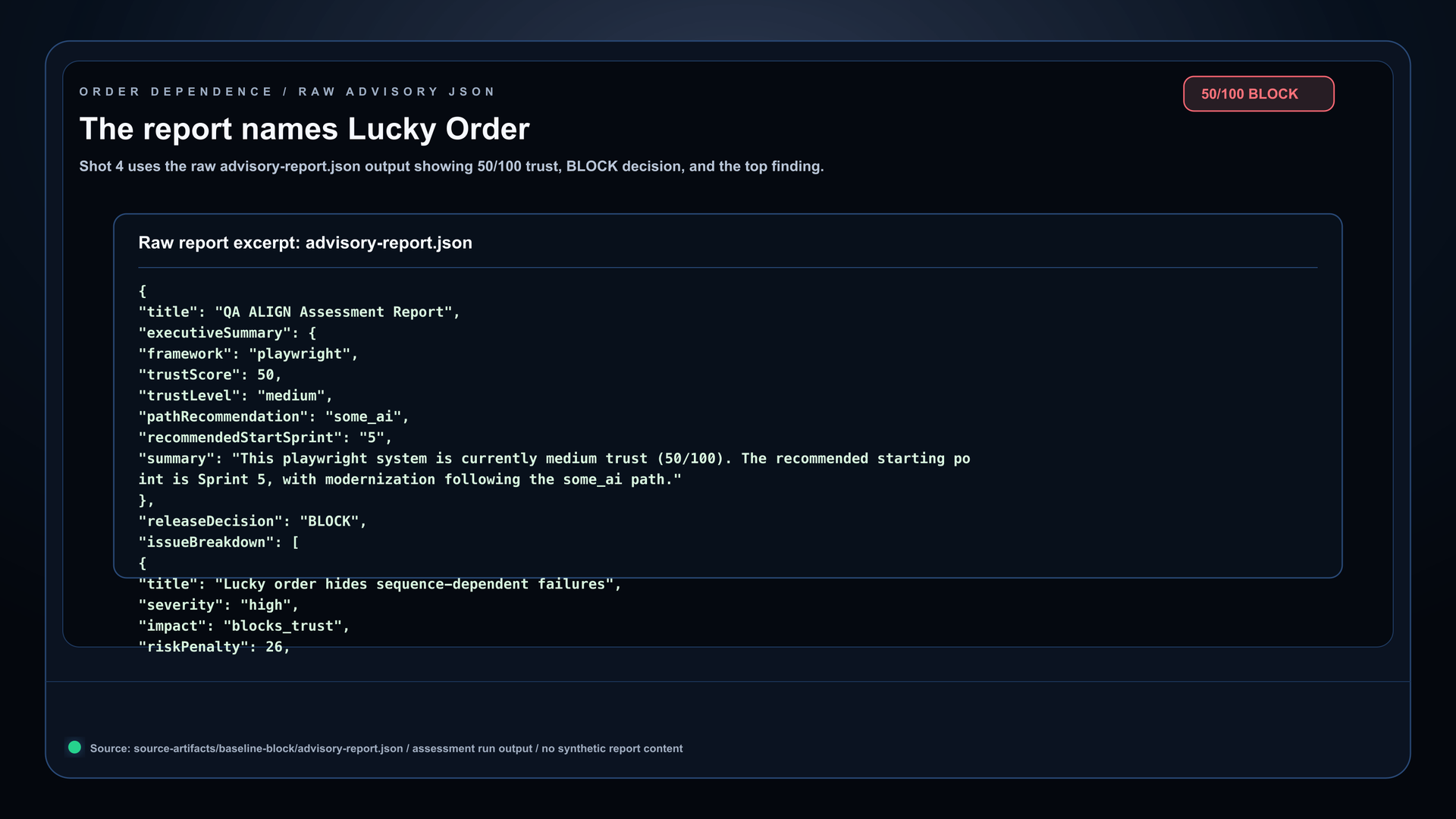
Order Dependence client report naming the lucky-order finding

2. How the report names it

The client report names Lucky Order as the top issue, shows the verified 50/100 baseline, and keeps release at BLOCK.

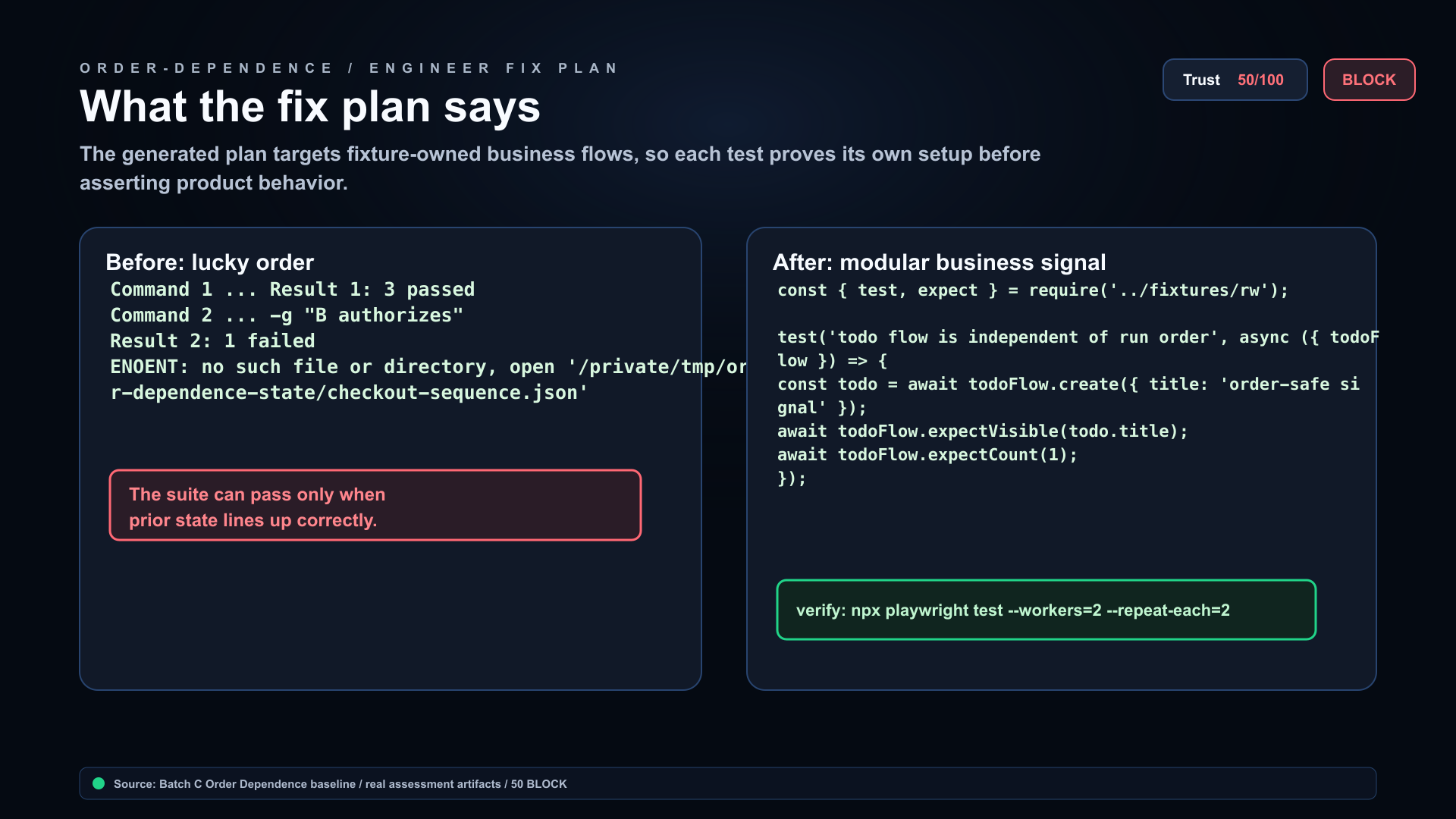
Order Dependence engineer fix plan targeting fixture-owned business flow

3. What the fix plan says

The fix plan turns the sequence-bound flow toward fixtures/rw.js and fixture-owned business signals.

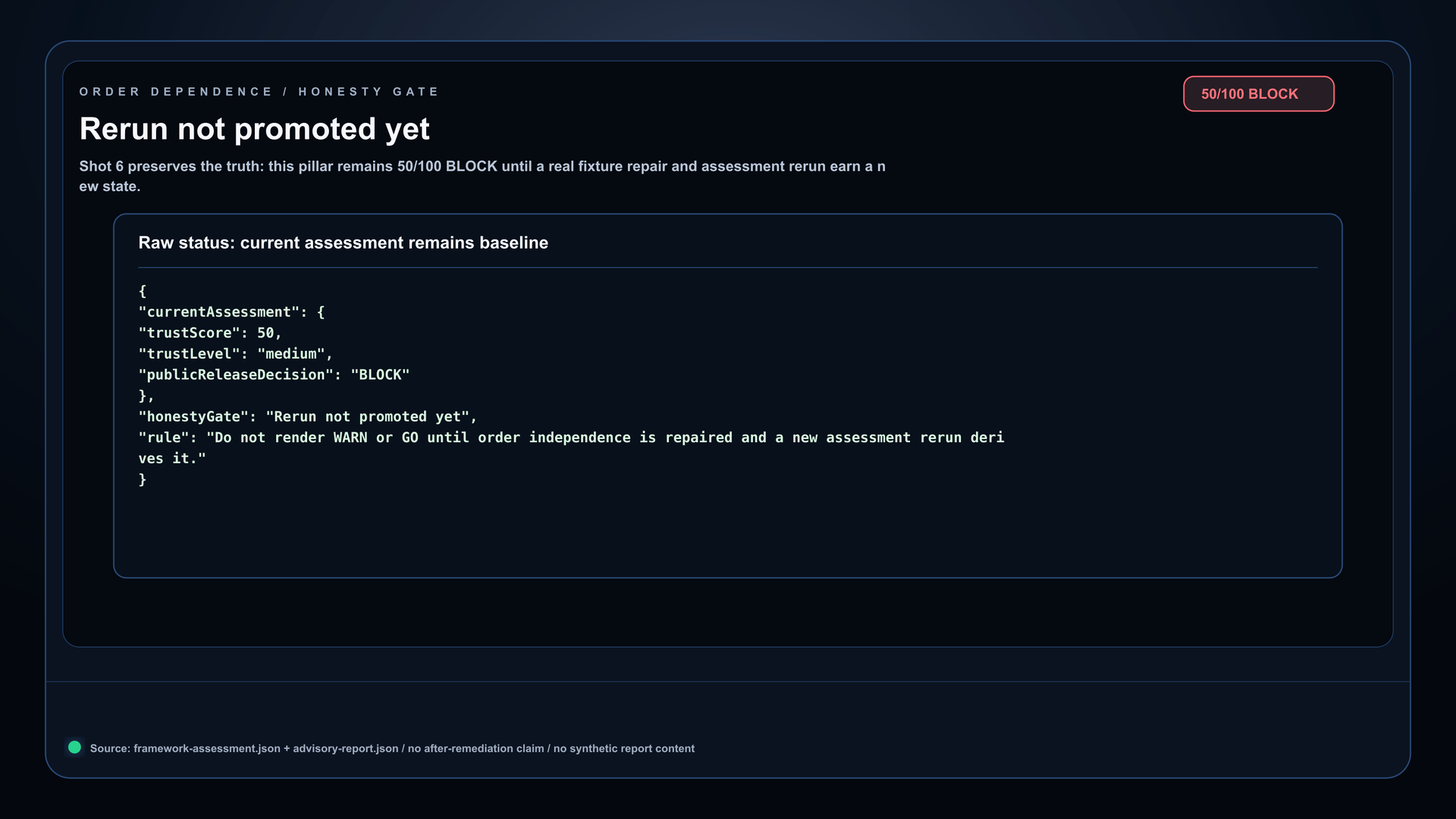
Order Dependence pending rerun status

4. Rerun status

The verified baseline remains 50/100 BLOCK until the fixture repair is implemented and a real assessment proves order independence.

Report outcomes

Know what is breaking trust before buying remediation

  • See which tests depend on execution order
  • Separate sequence risk from product, data, timing, and locator failures
  • Understand which setup, teardown, and state reset contracts are missing
  • Review weighted pricing for order-independent remediation
  • Give engineers line-level isolation targets after approval

Request the report

Only your email is required to begin. Add technical context only if it is useful.

Add optional context

Private intake. The external report is for your team. Internal engineer fix docs are not public-facing.