






Playwright Scale Risk

Keep Playwright Fast Without Losing Trust

Get a report that identifies the Playwright framework patterns that can create noisy CI, weak artifacts, or unstable scale as the suite grows.

External report for the client. Internal engineer fix document is created after approval to accelerate remediation.

Experienced improving systems for:

What QA ALIGN queries

Anti-patterns hiding inside the current framework

  • Trace, video, and screenshot policies are not tied to failure value
  • Fixtures mix setup, state, and assertions in ways that are hard to diagnose
  • Parallelism creates hidden data or account collisions
  • Retries are used before the failure taxonomy is understood
  • Report output does not support GO / WARN / BLOCK decisions
What the client receives

An external report with issues, trust level, and prices

  • Detected framework anti-patterns with affected areas
  • Current framework trust level
  • Issue evidence and severity
  • Weighted prices to fix the recommended changes
  • Recommended first remediation path

Sample finding

Speed is outpacing the evidence model

Playwright can move quickly, but speed only helps when failures remain diagnosable. QA ALIGN checks whether scale is weakening evidence quality.

Detected anti-pattern

The report prices fixes that preserve Playwright speed while improving framework trust.

Current assessment scenario

Playwright Scale Risk Client Assessment Story

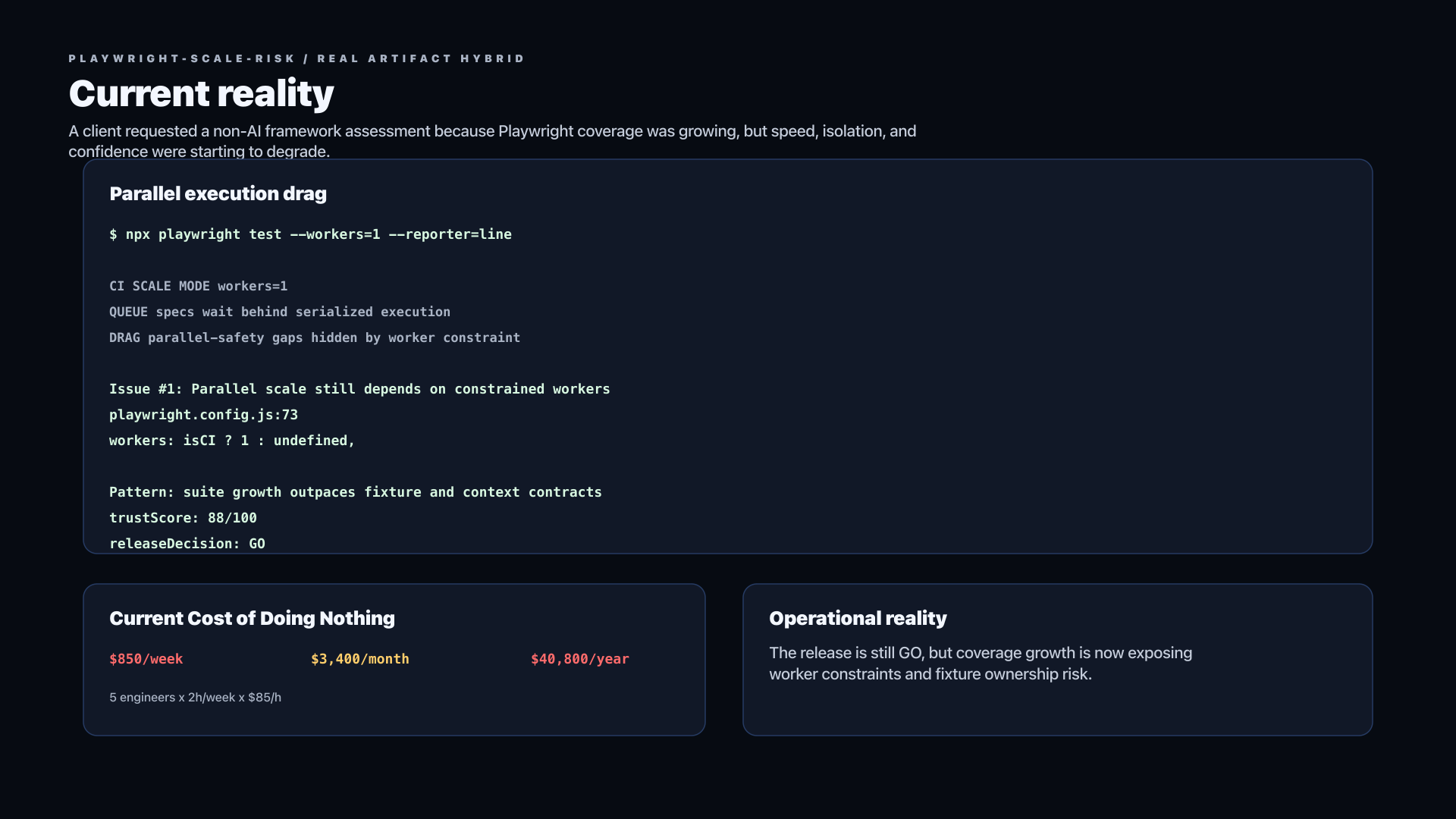
A client requested a non-AI framework assessment because Playwright coverage was growing, but speed, isolation, and confidence were starting to degrade.

Playwright Scale Risk Client Assessment Story assessment evidence preview
What QA ALIGN found

QA ALIGN found scale risks in fixtures, data setup, project configuration, artifact capture, locator governance, or parallel execution. The assessment produces an engineer fix report with affected Playwright config, fixtures, page objects, helpers, and specs plus line-level scale-hardening targets.

Evidence reviewed
  • Playwright config and fixture findings
  • Parallel/data/artifact evidence
  • Affected Playwright file line numbers
  • Rerun scale-readiness result
Assessment decision

After the engineer implements the fix and reruns the framework assessment, the Playwright scale risk that caused the BLOCK is cleared, trust level moves to high, and the release decision becomes GO.

Playwright Scale Risk proof

Four real snapshots from the Playwright Scale Risk fix.

The evidence follows the real framework finding through assessment, engineering remediation, and a rerun showing trust improved from 88 to 94 while release is GO.

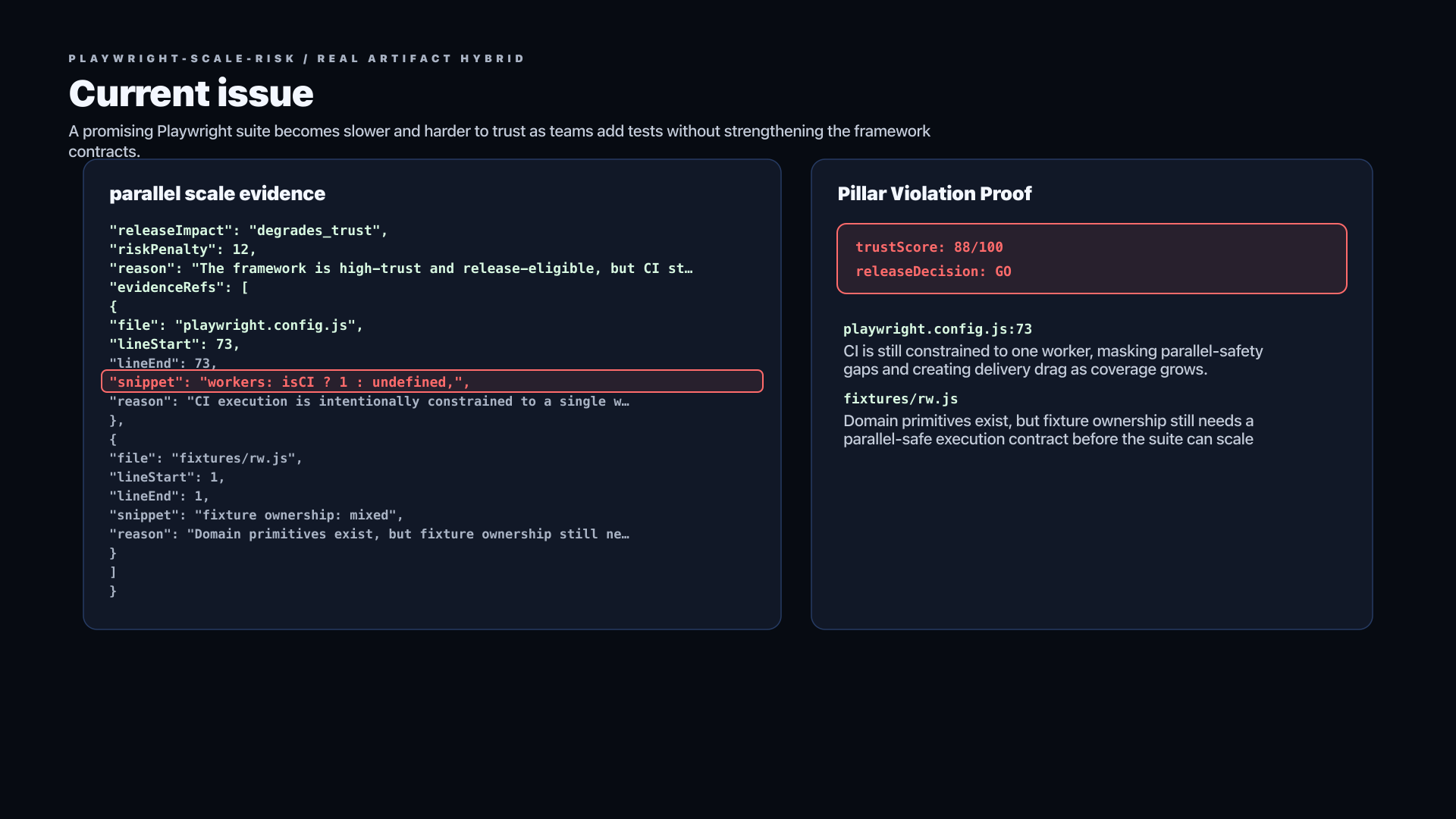
Playwright Scale Risk raw issue evidence

1. The issue in JSON

The raw snapshot shows the scale bottleneck: growing Playwright coverage is still constrained by fixture, worker, or context ownership.

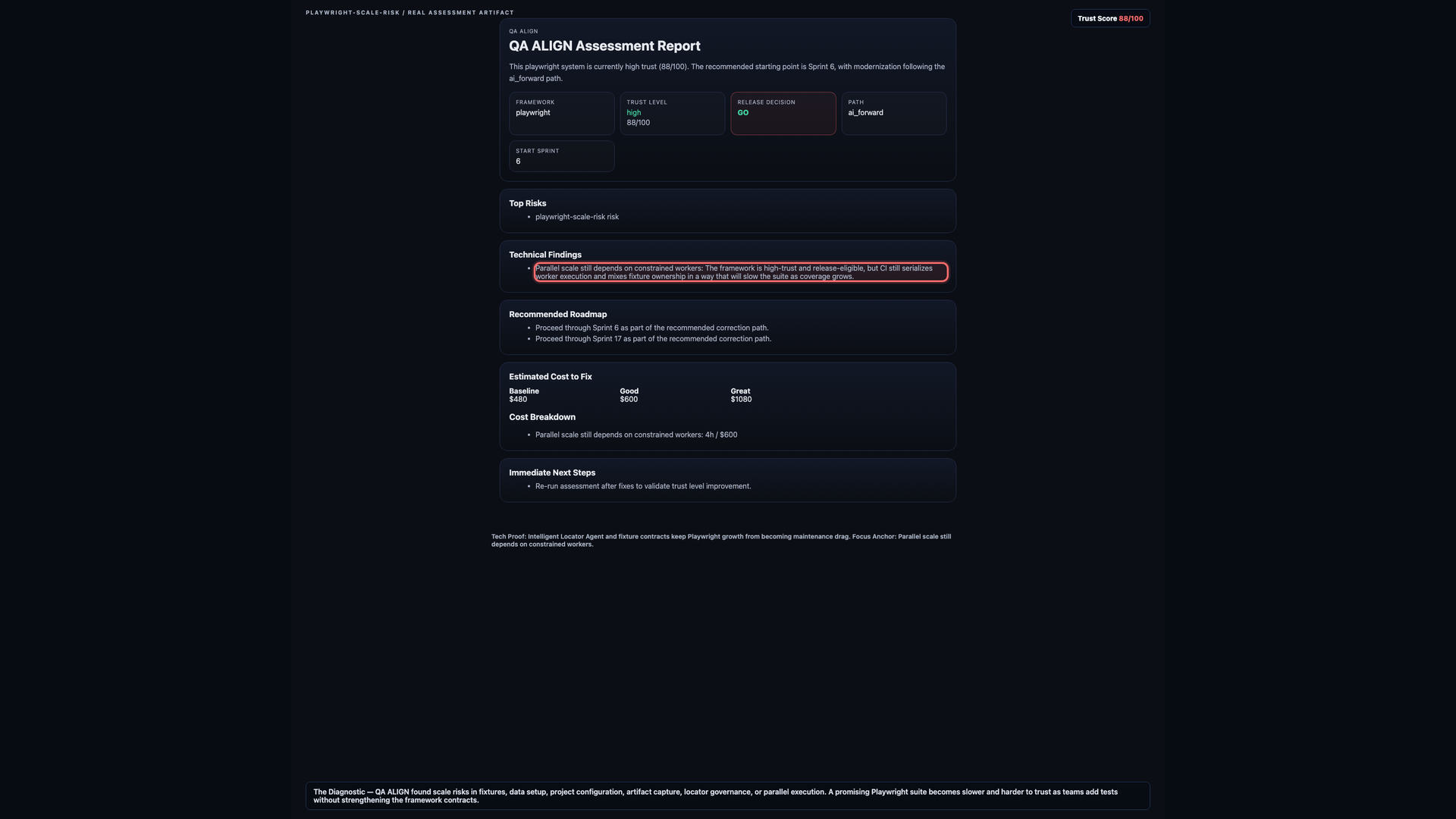
Playwright Scale Risk assessment report naming the issue

2. How the report names it

The report names scale risk without pretending the suite is broken; the issue is whether trust can survive growth.

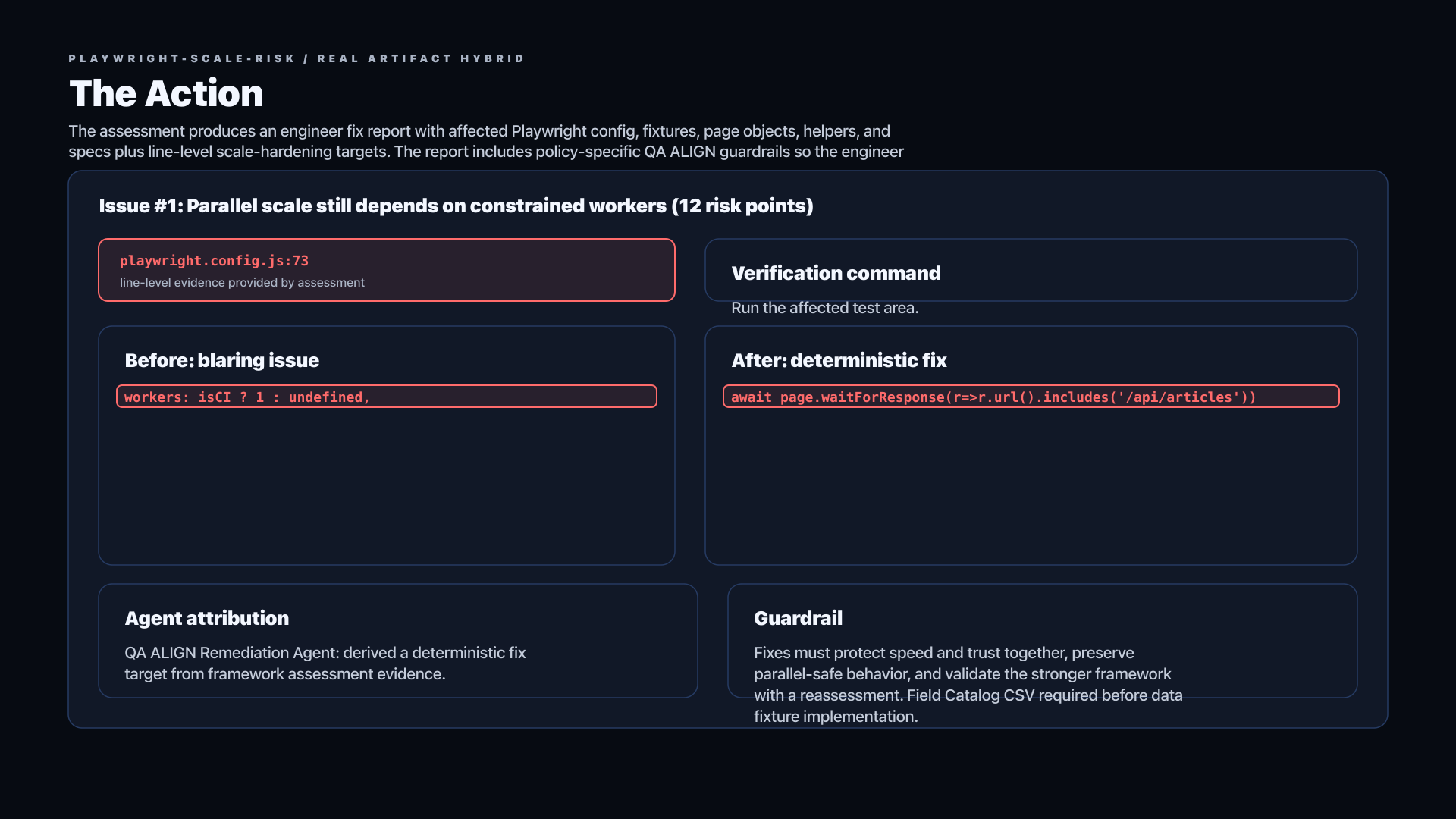
Playwright Scale Risk engineer fix plan for the issue

3. What the fix plan says

The fix plan focuses on fixture-driven parallelization so specs consume shared primitives instead of managing their own contexts.

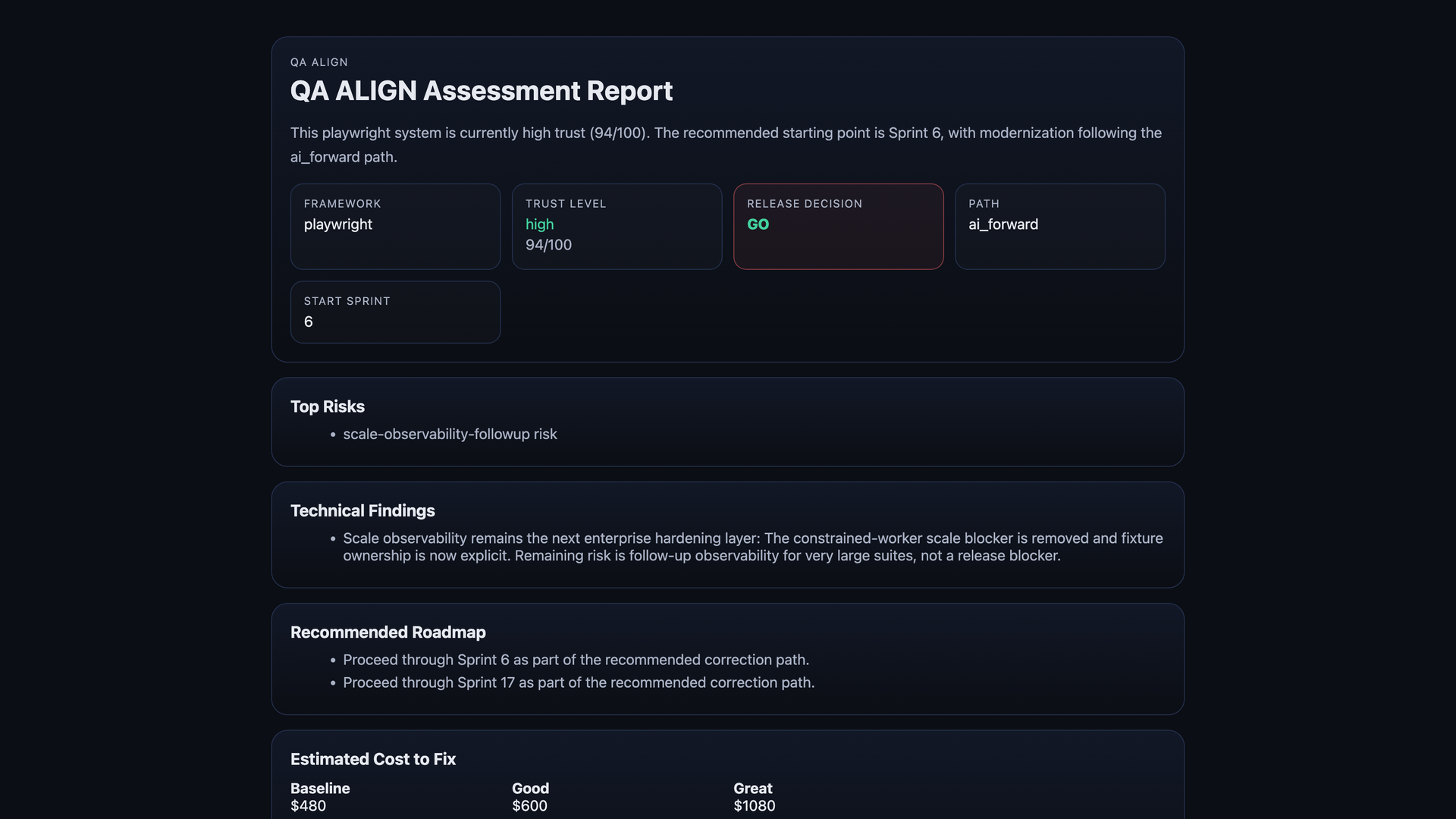
Playwright Scale Risk rerun report after remediation

4. New report after rerun

A verified rerun measures the scalability protection earned and records the framework at 94/100 GO.

Report outcomes

Know what is breaking trust before buying remediation

  • See whether Playwright scale is creating hidden trust risk
  • Understand fixture, artifact, and parallelization gaps
  • Know which fixes protect speed and confidence together
  • Review weighted pricing for Playwright framework improvements
  • Give engineers internal implementation guidance after approval

Request the report

Only your email is required to begin. Add technical context only if it is useful.

Add optional context

Private intake. The external report is for your team. Internal engineer fix docs are not public-facing.