






Rerun-Based Debugging

Stop Using Reruns as the Debugging Strategy

Get a report that identifies where rerun culture is wasting engineering time, masking the original failure, and delaying release decisions.

External report for the client. Internal engineer fix document is created after approval to accelerate remediation.

Experienced improving systems for:

What QA ALIGN queries

Anti-patterns hiding inside the current framework

  • The first failed run is ignored instead of diagnosed
  • Retries overwrite or hide the first failure condition
  • CI status is treated as reliable only after repeated reruns
  • Flake patterns are not classified before reruns are triggered
  • Time-to-diagnosis depends on waiting for a later run to pass or fail differently
  • The team needs reruns before assigning ownership
What the client receives

An external report with issues, trust level, and prices

  • Detected framework anti-patterns with affected areas
  • Current framework trust level
  • Issue evidence and severity
  • Weighted prices to fix the recommended changes
  • Recommended first remediation path

Sample finding

The first failure is disposable

When reruns become normal, the first failure stops being treated as the source of truth. QA ALIGN checks whether retries are masking the original condition and whether the first failed run can be classified before another run starts.

Detected anti-pattern

Current trust stays low while release decisions depend on repeated runs. The report prices the fixes that make the first failure actionable and reduce time-to-diagnosis.

Current assessment scenario

Rerun Based Debugging Client Assessment Story

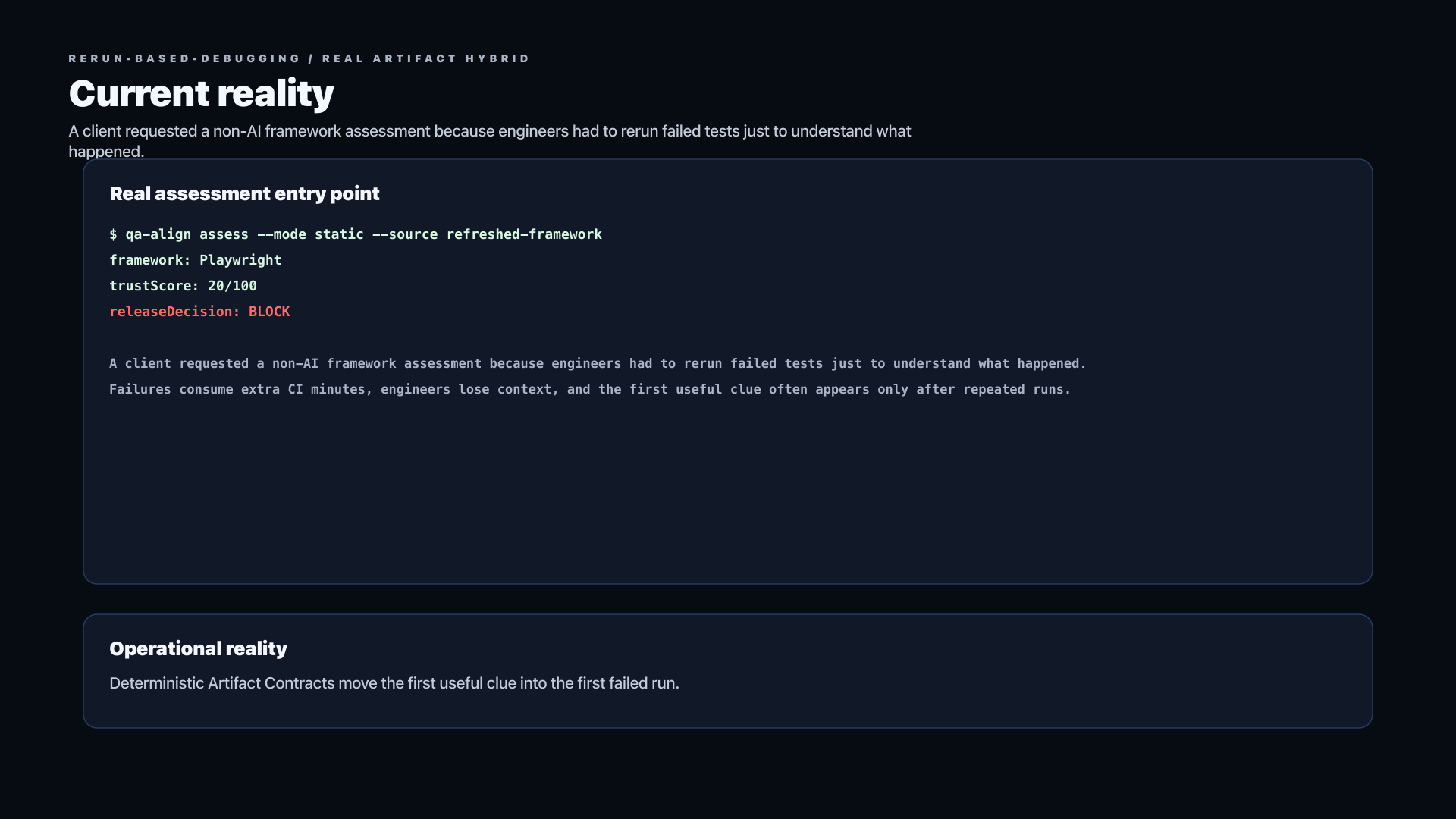
A client requested a non-AI framework assessment because engineers had to rerun failed tests just to understand what happened.

Rerun Based Debugging Client Assessment Story assessment evidence preview
What QA ALIGN found

QA ALIGN found weak first-run diagnosability: the initial failure did not preserve enough evidence to classify and act. The assessment produces an engineer fix report with affected reporter, fixture, trace, and test files plus line-level targets for preserving first-failure evidence.

Evidence reviewed
  • Initial failed run artifacts
  • Retry history
  • Affected reporter or fixture files and line numbers
  • First-failure rerun evidence
Assessment decision

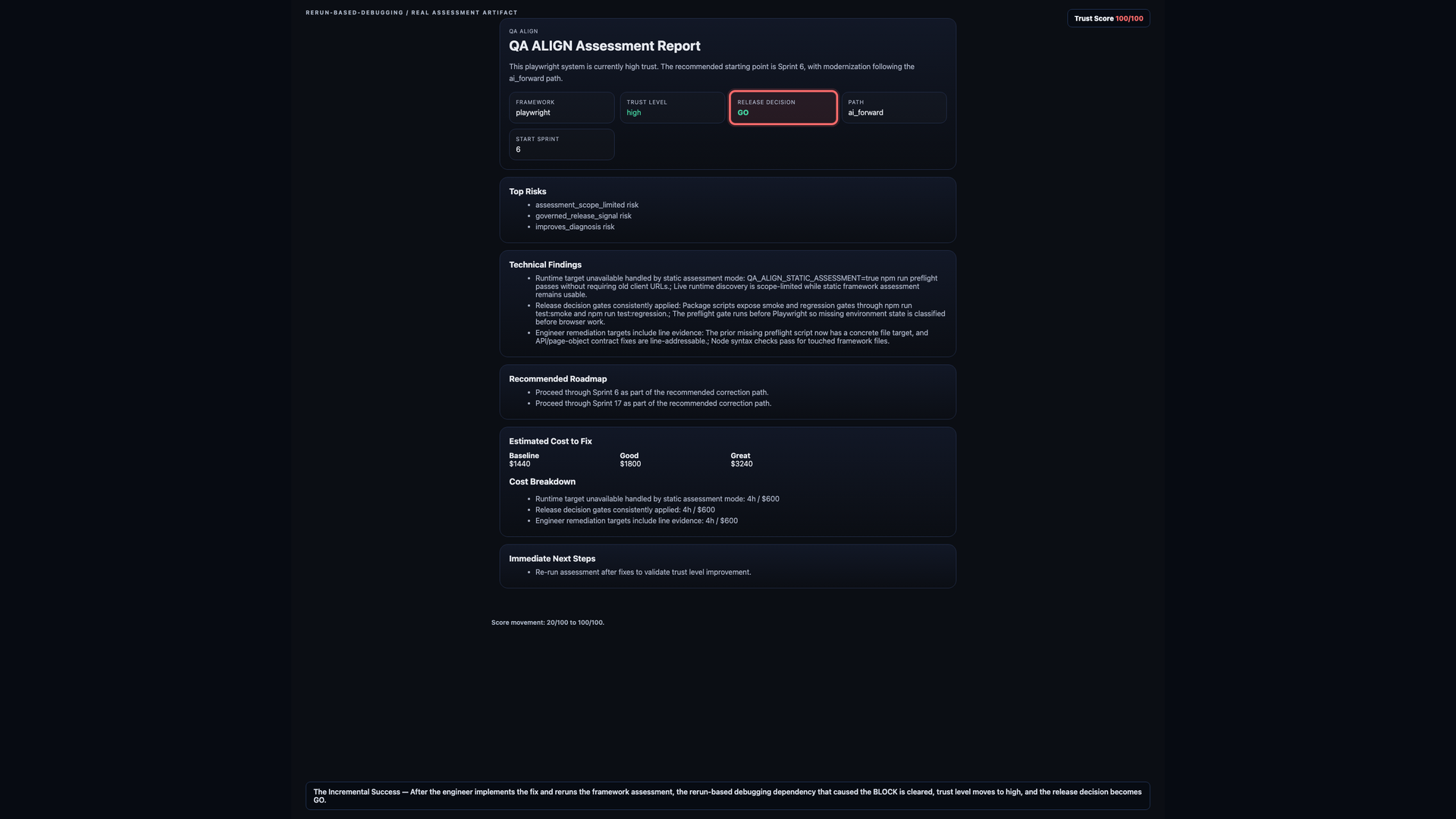
After the engineer implements the fix and reruns the framework assessment, the rerun-based debugging dependency that caused the BLOCK is cleared, trust level moves to high, and the release decision becomes GO.

Rerun Based Debugging proof

Four real snapshots from the Rerun Based Debugging fix.

The evidence connects the raw issue, assessment report, engineer fix plan, and rerun result.

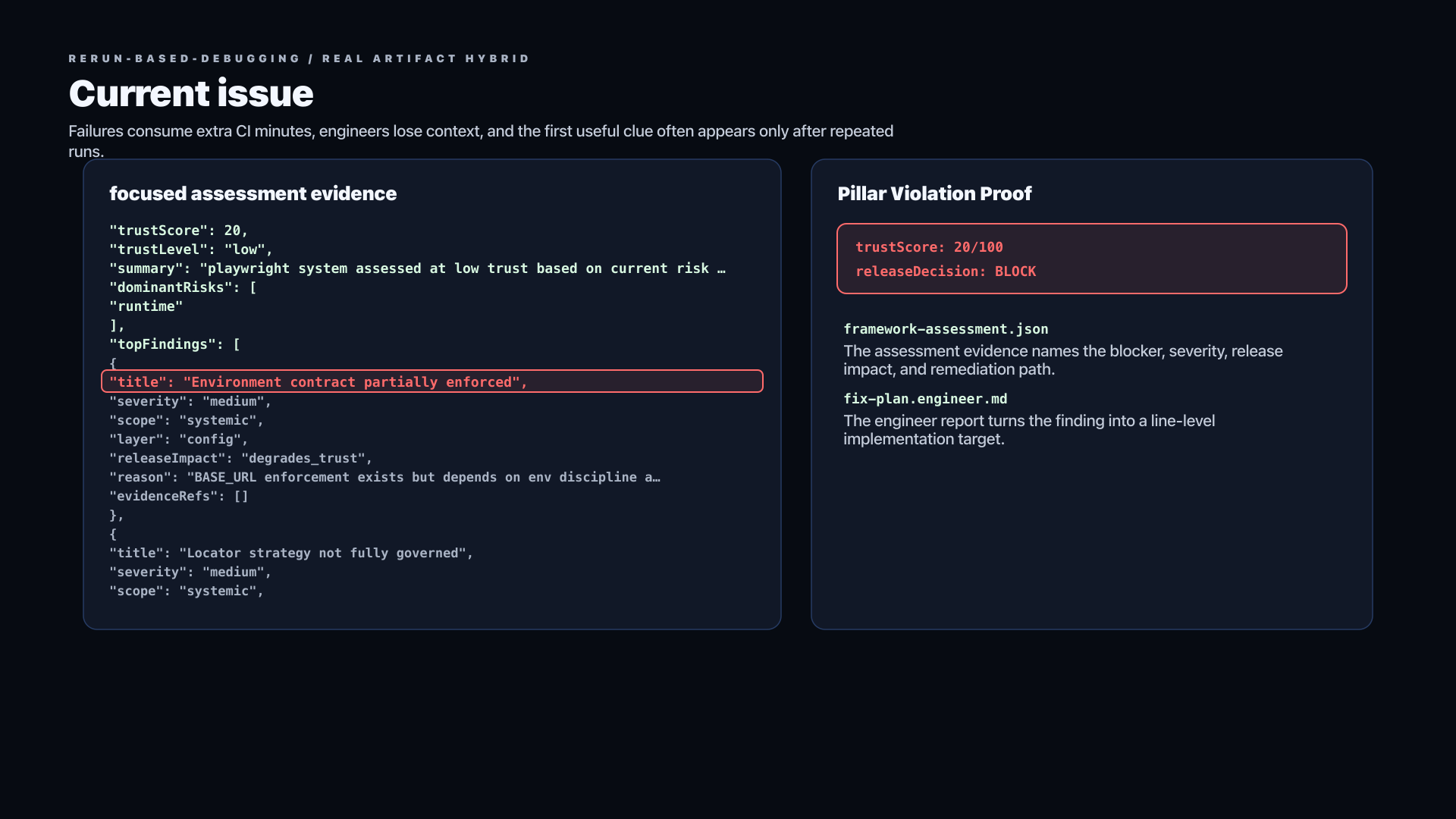
Rerun Based Debugging raw issue evidence

1. The issue in JSON

The baseline snapshot shows the top finding: Environment contract partially enforced.

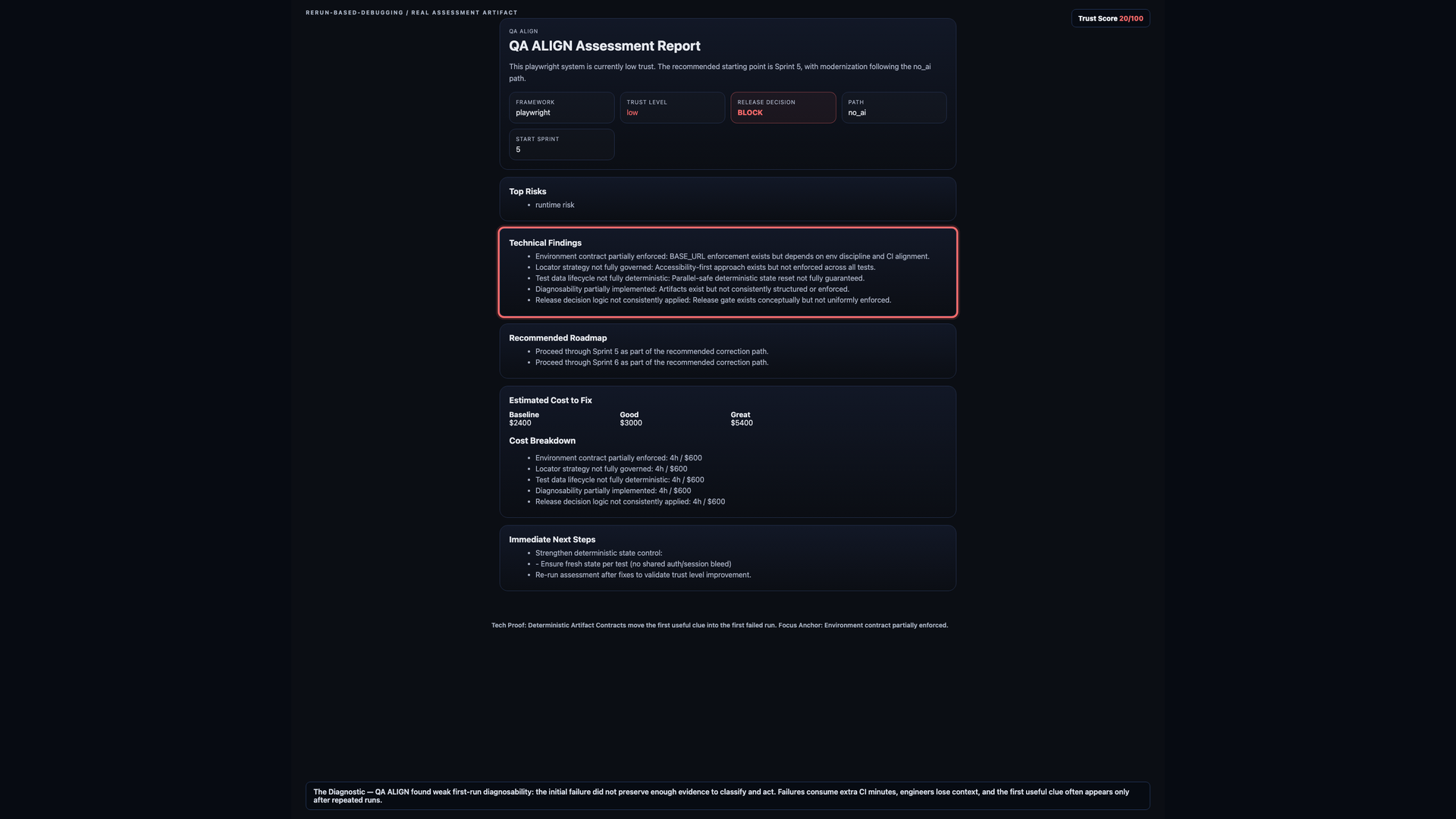
Rerun Based Debugging assessment report naming the issue

2. How the report names it

The client report names the issue and ties the recommendation directly to the observed finding.

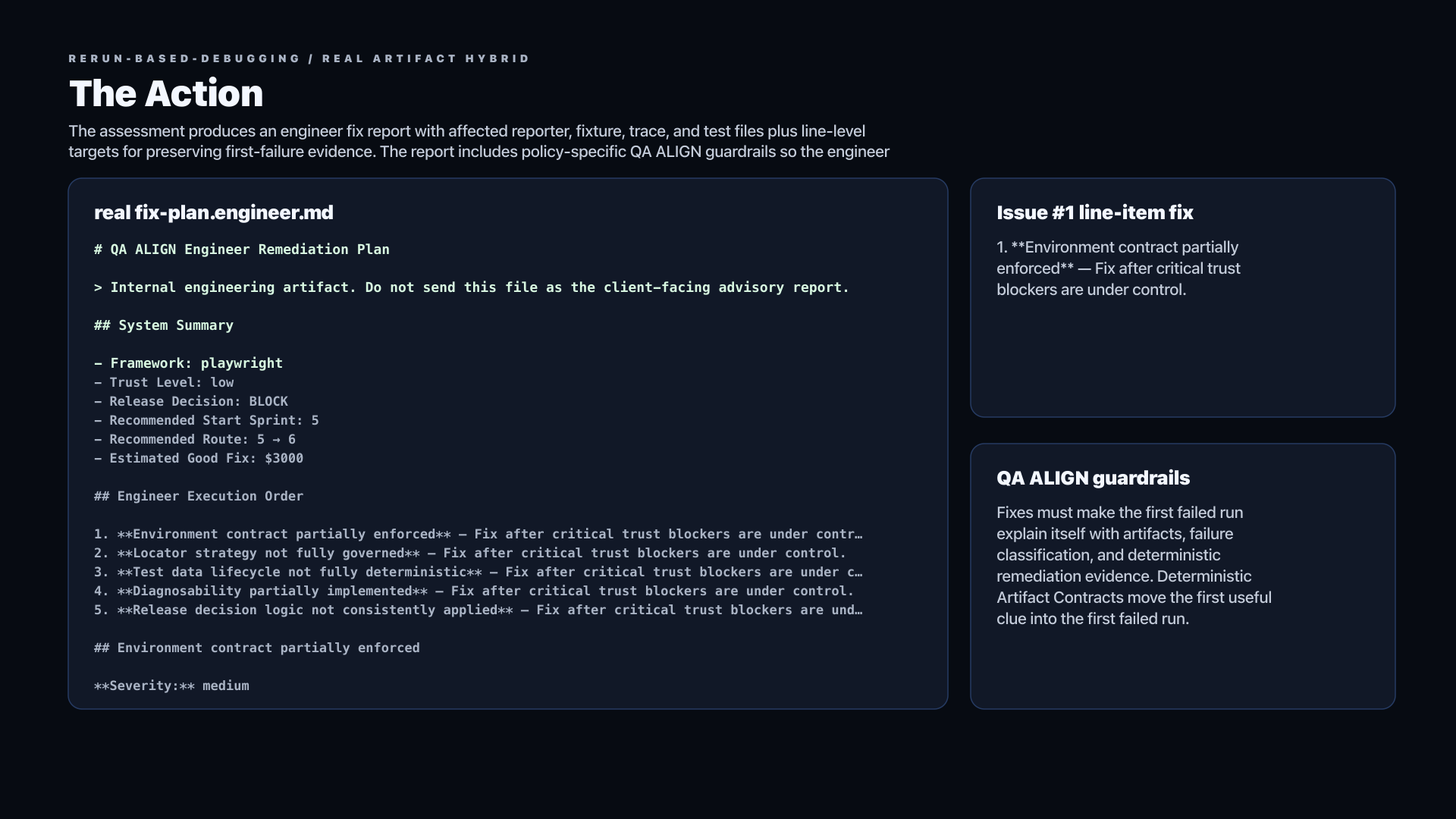
Rerun Based Debugging engineer fix plan for the issue

3. What the fix plan says

The engineer fix plan focuses the remediation on this specific issue instead of drifting into a generic framework cleanup.

Rerun Based Debugging rerun report after remediation

4. New report after rerun

After the fix, the rerun report shows the updated trust state and the next highest-priority risk.

Report outcomes

Know what is breaking trust before buying remediation

  • See where reruns are acting as the diagnosis layer
  • Understand why the first failure is not trusted today
  • Know which framework changes reduce rerun waste fastest
  • Review weighted prices for first-run diagnosability improvements
  • Give engineers internal instructions for accepted diagnosis fixes

Request the report

Only your email is required to begin. Add technical context only if it is useful.

Add optional context

Private intake. The external report is for your team. Internal engineer fix docs are not public-facing.