






Shared State Leaks

Stop Shared State Leaks from Polluting Release Signals

Get a trust report that identifies where shared state, order dependence, and weak cleanup are making automation results unreliable.

External report for the client. Internal engineer fix document is created after approval to accelerate remediation.

Experienced improving systems for:

What QA ALIGN queries

Anti-patterns hiding inside the current framework

  • Tests depend on execution order or previous scenario side effects
  • Browser, session, database, or service state is reused accidentally
  • Cleanup routines fail silently or only run on happy paths
  • Parallel runs create collisions across accounts or records
  • Reports do not identify state leakage as the failure category
What the client receives

An external report with issues, trust level, and prices

  • Detected framework anti-patterns with affected areas
  • Current framework trust level
  • Issue evidence and severity
  • Weighted prices to fix the recommended changes
  • Recommended first remediation path

Sample finding

Suite order changes the truth

If changing test order changes the result, the framework cannot be trusted as a release signal. QA ALIGN checks for state leakage and missing isolation contracts.

Detected anti-pattern

The report prices the fixes needed to make tests independent enough for trustworthy CI execution.

Current assessment scenario

Shared State Leaks Client Assessment Story

A client requested a non-AI framework assessment because tests passed alone but failed when they ran after other scenarios.

Shared State Leaks Client Assessment Story assessment evidence preview
What QA ALIGN found

QA ALIGN found shared state leakage across browser sessions, test data, services, and setup or cleanup boundaries. The assessment produces an engineer fix report focused on fixtures/rw.js, worker-scoped isolation, and line-level reset targets.

Evidence reviewed
  • Run order evidence
  • Setup and cleanup findings
  • Affected fixture/spec line numbers
  • Rerun isolation result
Assessment decision

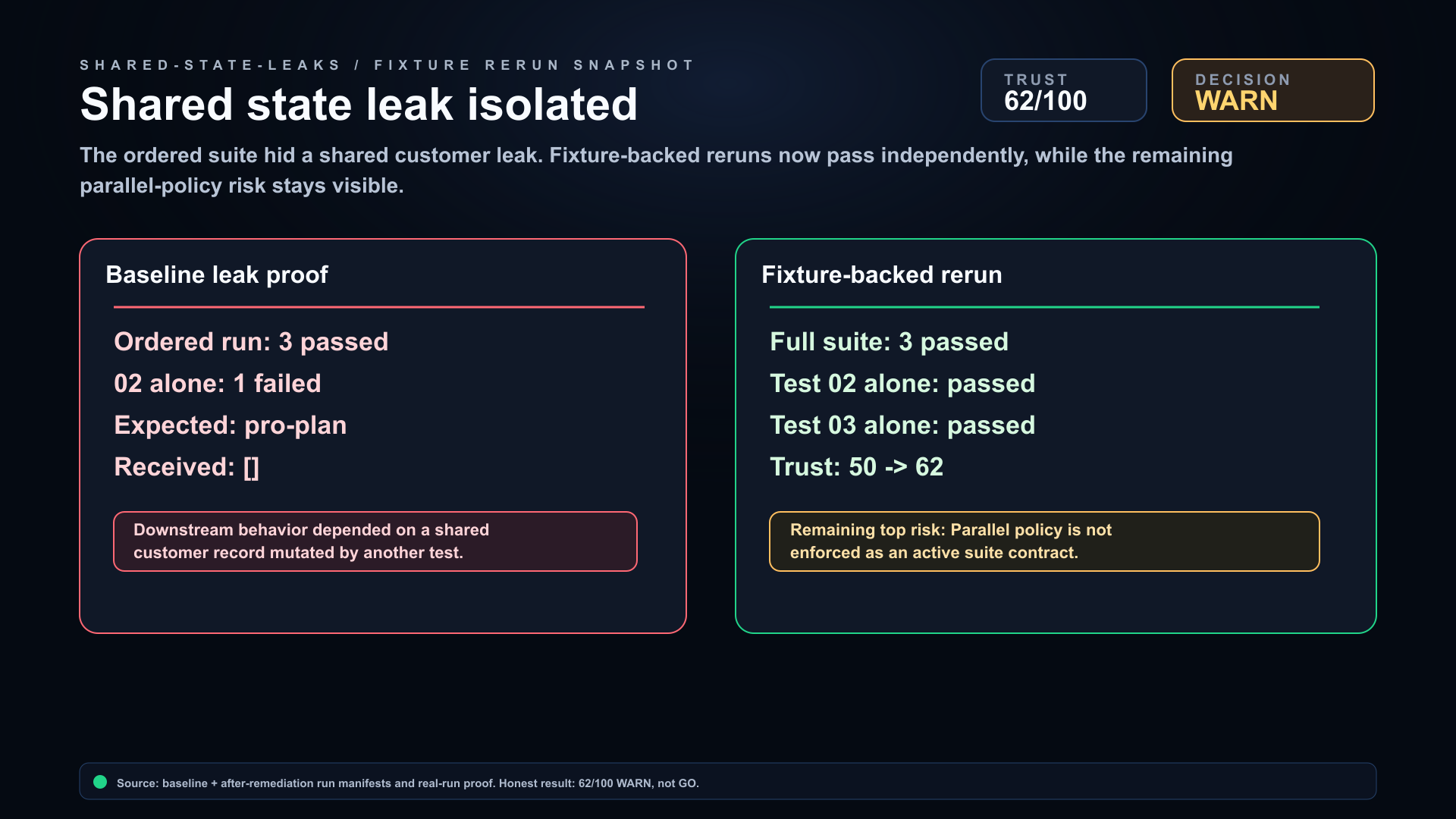
After the fixture-backed state repair, the verified rerun moves to 62/100 WARN. The shared customer leak is removed, while suite-wide fixture adoption, CI gate enforcement, and parallel policy remain visible risks.

Shared State Leaks proof

Four real snapshots from the Shared State Leaks fix.

The evidence follows the real framework finding through assessment, engineering remediation, and a rerun showing trust improved from 50 to 62 while release is WARN.

Shared State Leaks current reality showing suite order as a hidden dependency

1. The issue in the run

The baseline story shows toothbrush sharing: tests pass alone, then fail after another scenario leaves session or data behind.

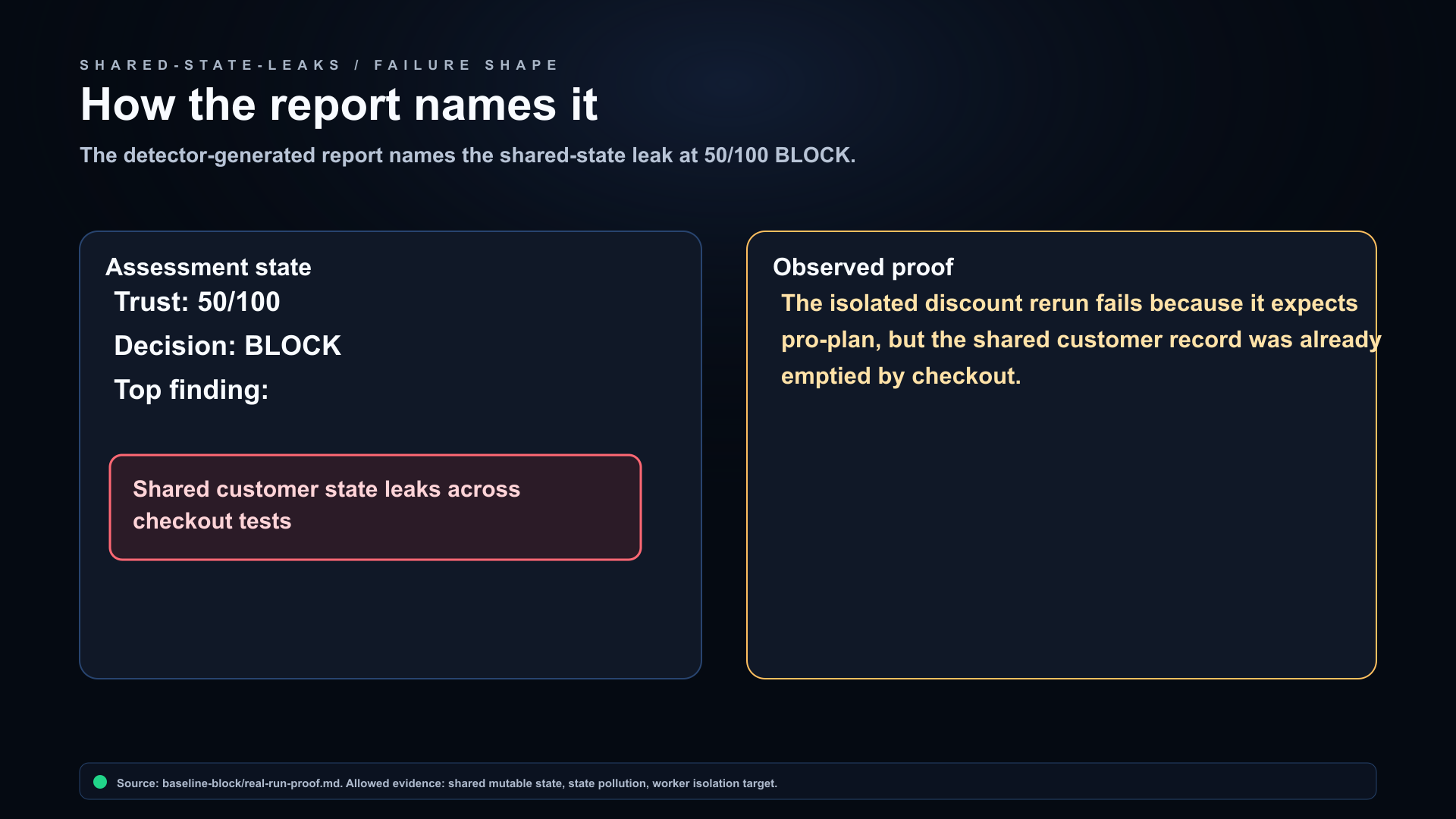
Shared State Leaks client report naming the shared mutable state finding

2. How the issue shows up

The detector-generated report shows the repaired state at 62/100 WARN and names the remaining execution-control risks.

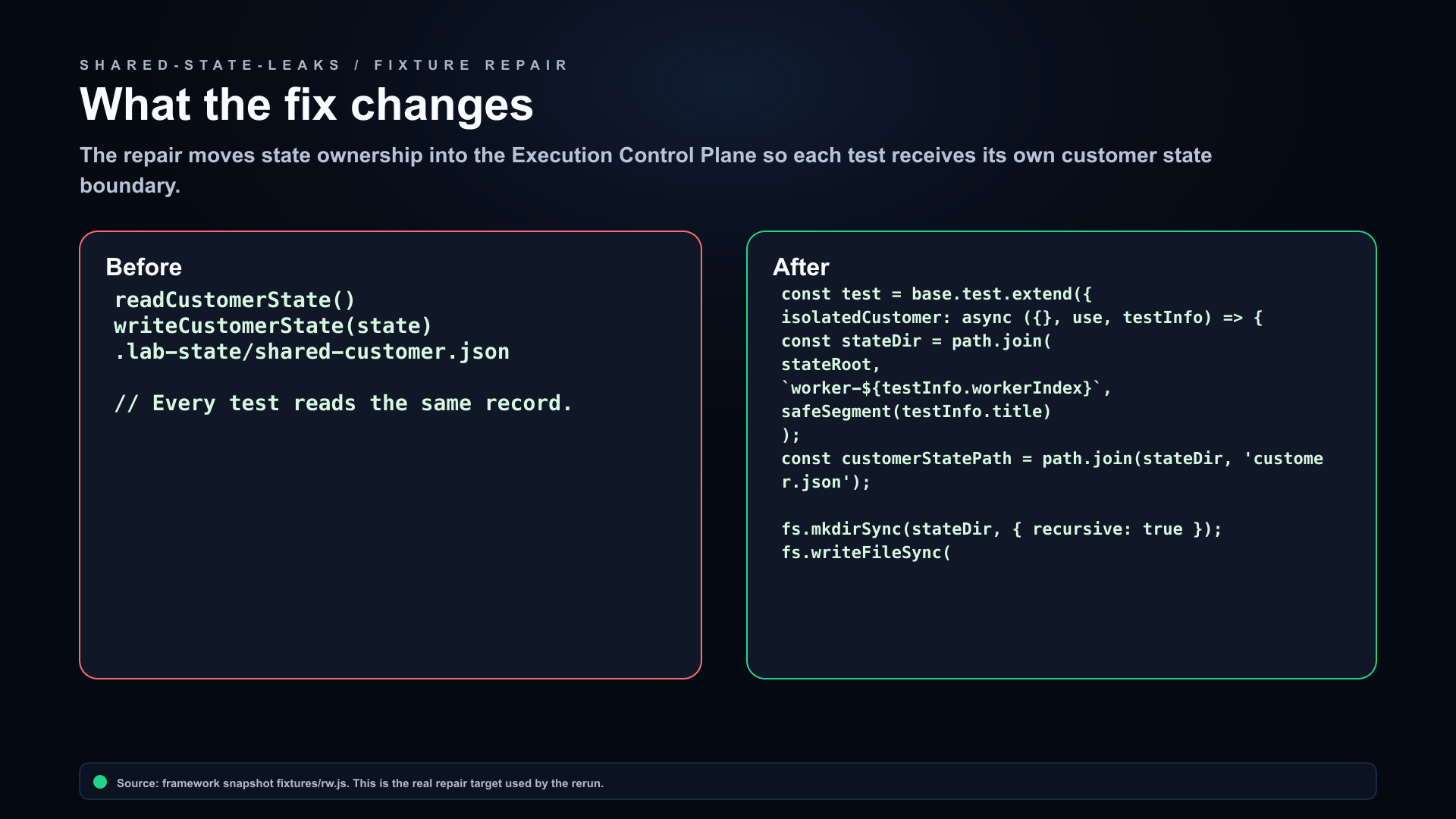
Shared State Leaks engineer fix plan targeting worker-scoped fixture isolation

3. What the fix plan says

The fix plan turns the finding into a worker-scoped fixtures/rw.js repair and verification command.

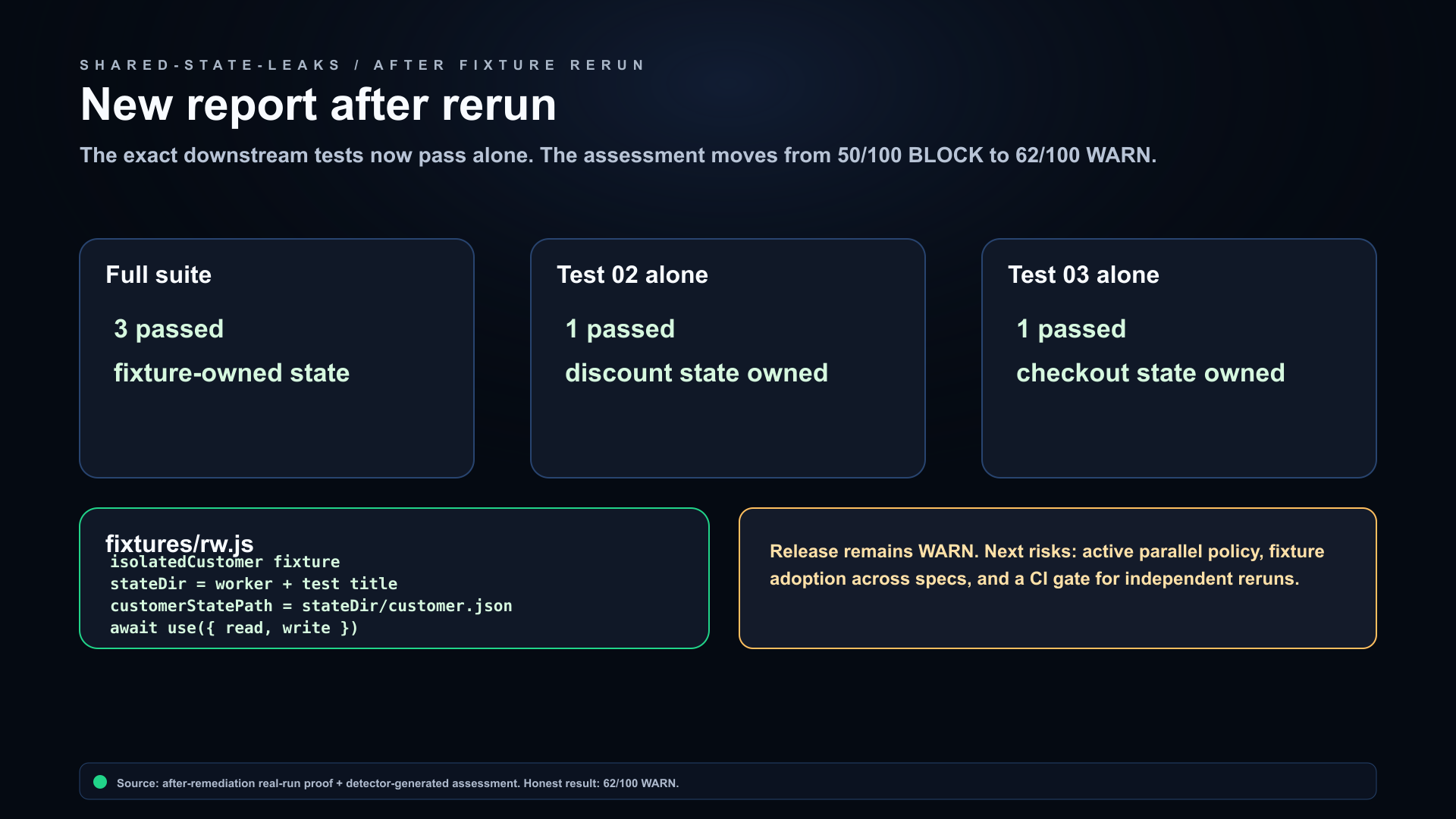
Shared State Leaks rerun report

4. New report after rerun

After the fixture repair, the assessment moves to 62/100 WARN. The shared customer leak is removed; CI gate and suite-wide fixture adoption are now on top.

Report outcomes

Know what is breaking trust before buying remediation

  • See which state boundaries are leaking
  • Understand how state leaks affect current trust level
  • Know which reset contracts should be fixed first
  • Review weighted pricing for state isolation improvements
  • Give engineers an internal fix document after approval

Request the report

Only your email is required to begin. Add technical context only if it is useful.

Add optional context

Private intake. The external report is for your team. Internal engineer fix docs are not public-facing.