






Test Data Chaos

Eliminate the Hidden Dependencies in Your Test Data

QA ALIGN checks how test data is created, reused, reset, and observed, then uses URL discovery to produce field-level contracts when data-driven setup is in scope.

External report for the client. Internal engineer fix document is created after approval to accelerate remediation.

Experienced improving systems for:

What QA ALIGN queries

Anti-patterns hiding inside the current framework

  • Tests depend on shared accounts, shared records, or old database state
  • Setup steps are hidden inside UI flows instead of deterministic APIs
  • Field requirements are rediscovered manually instead of captured as a reusable data contract
  • Data cleanup is inconsistent or missing after failures
  • Scenarios mutate records that later tests expect to be stable
  • Failure output does not show the data state that caused the issue
What the client receives

An external report with issues, trust level, and prices

  • Detected framework anti-patterns with affected areas
  • Current framework trust level
  • Issue evidence and severity
  • Weighted prices to fix the recommended changes
  • Recommended first remediation path

Sample finding

Tests are borrowing data and field rules they do not control

Automation becomes fragile when scenarios depend on data created by other runs, users, or systems, or when field rules only live in human memory. QA ALIGN checks whether each test controls the state it needs and whether URL discovery can turn field behavior into a reusable contract.

Detected anti-pattern

The report prices the fixes needed to make test data deterministic enough to support reliable automation, and the Field Catalog CSV gives the team a practical seed for data-driven test creation.

Current assessment scenario

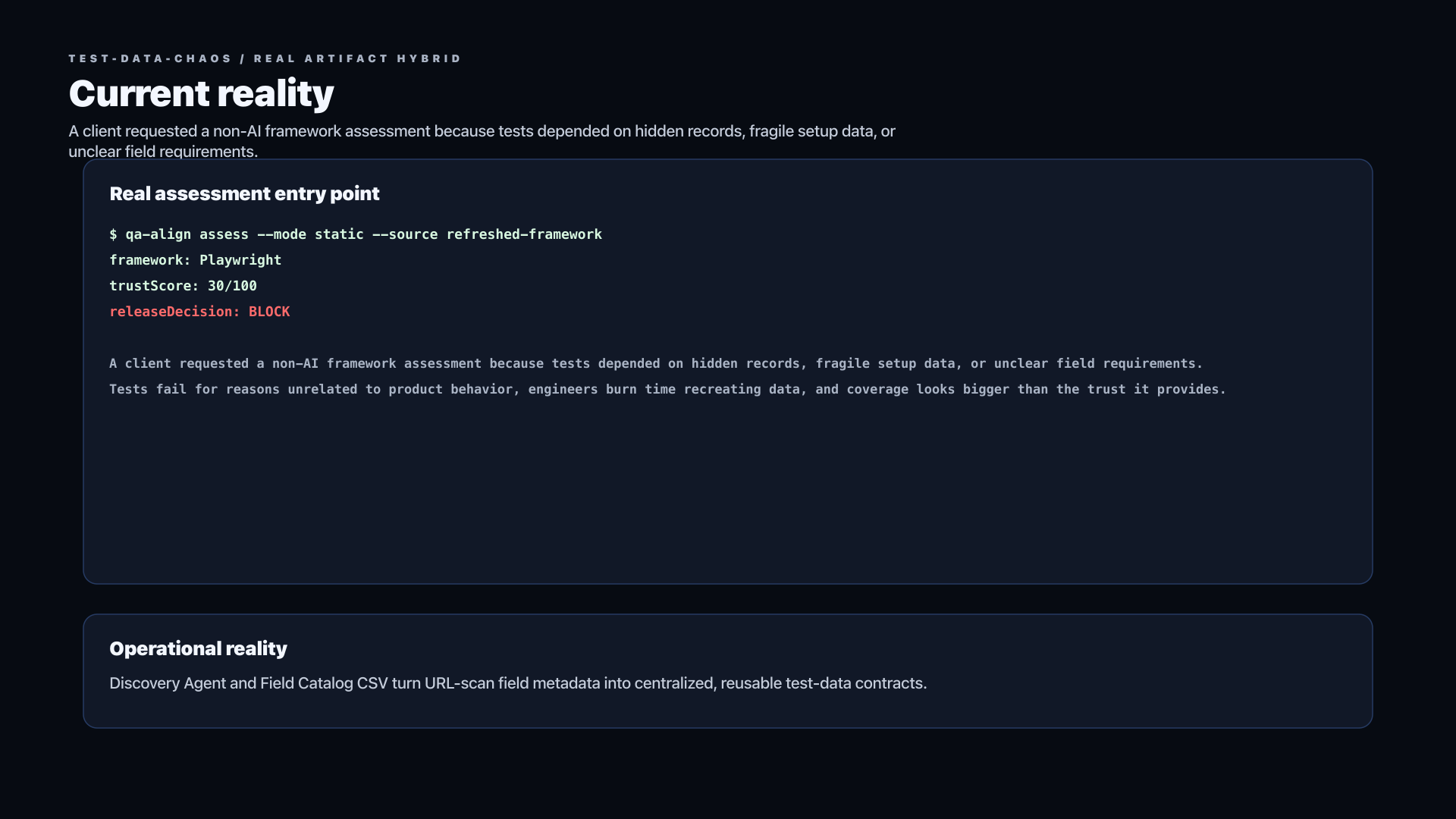
Test Data Chaos Client Assessment Story

The suite passes on Monday but fails on Tuesday because the test data lifecycle is not yet governed by a Field Catalog.

Test Data Chaos Client Assessment Story assessment evidence preview
What QA ALIGN found

QA ALIGN found hidden setup data, unclear field requirements, and lifecycle gaps that kept the framework at 30/100 BLOCK before the Field Catalog repair path.

Evidence reviewed
  • Field Catalog CSV contract
  • Fixture data creation findings
  • Affected fixture line numbers
  • Baseline and rerun reports
Assessment decision

After the Field Catalog repair path, trust improves from 30/100 BLOCK to 60/100 WARN. The data lifecycle risk is reduced, but the release signal remains honest because runtime risk is still on top.

Test Data Chaos proof

Four real snapshots from the Test Data Chaos fix.

The evidence follows the real framework finding through assessment, engineering remediation, and a rerun showing trust improved from 30 to 60 while release is WARN.

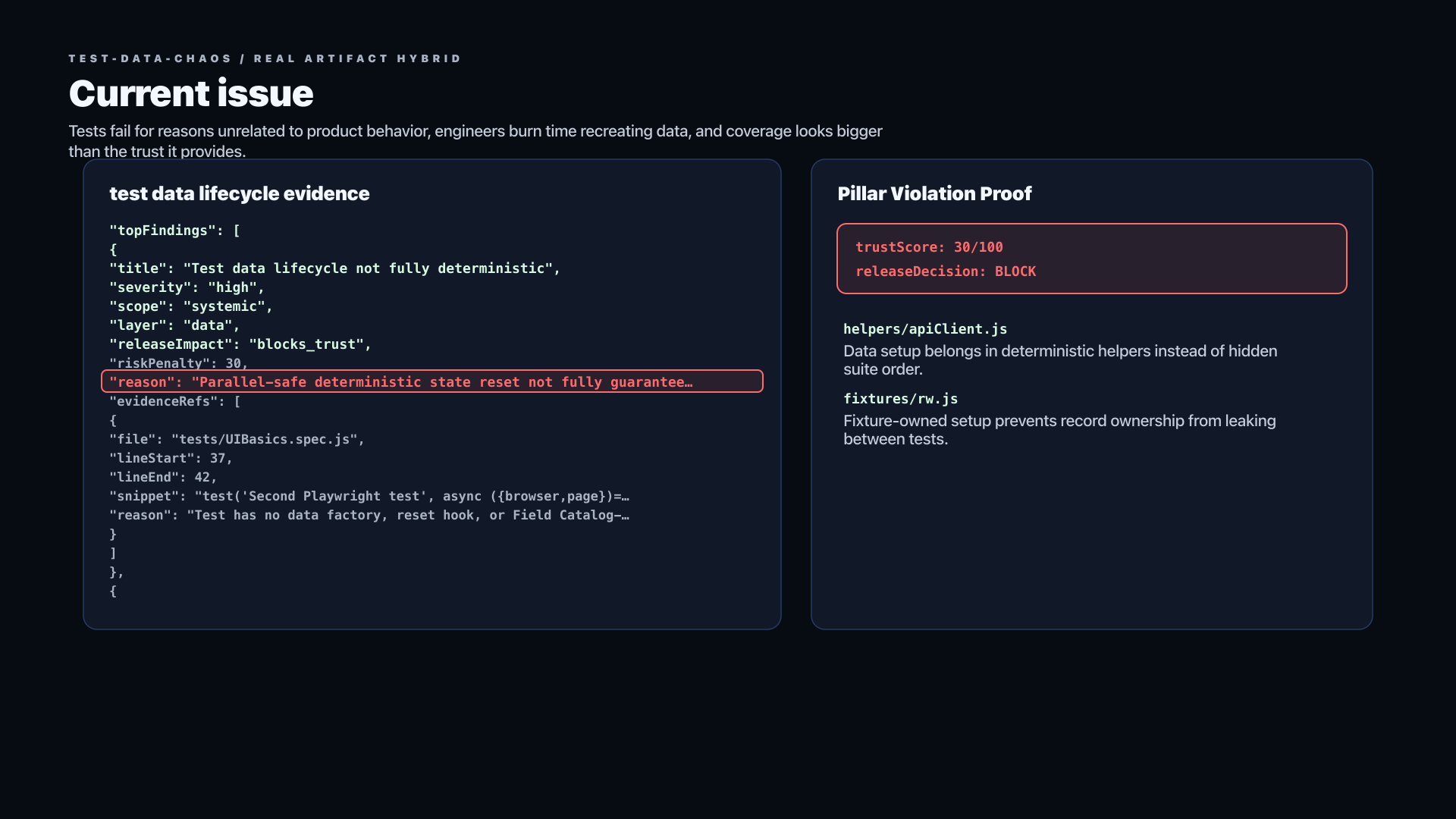
Test Data Chaos current issue showing missing data lifecycle control

1. The data lifecycle risk

The baseline snapshot shows the real data-control gap: setup dependencies and safe values are not yet governed by a Field Catalog.

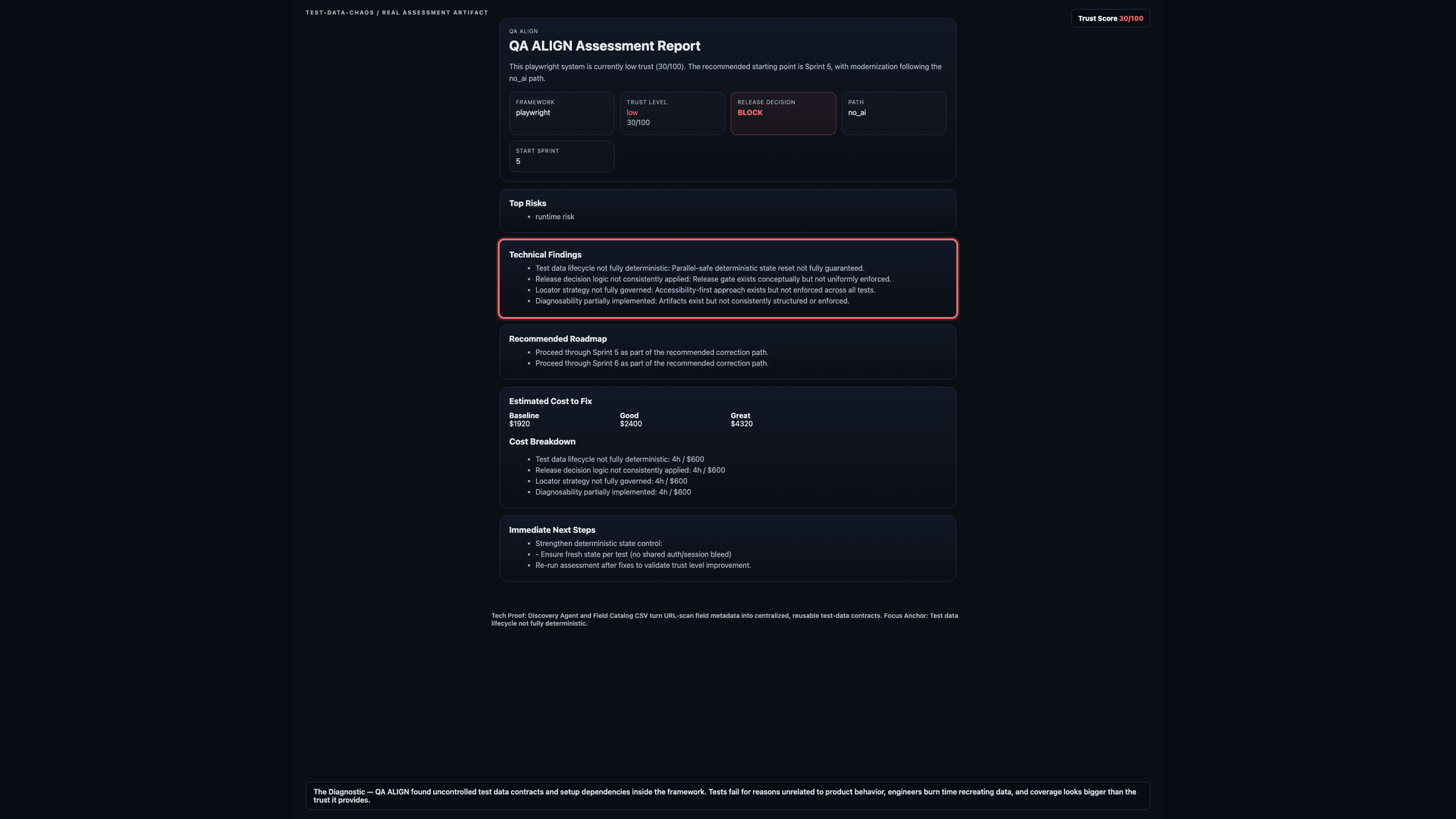
Test Data Chaos client report showing data lifecycle risk

2. How the report names it

The report names the lifecycle issue as a release-confidence blocker, with the real baseline sitting at 30/100 BLOCK.

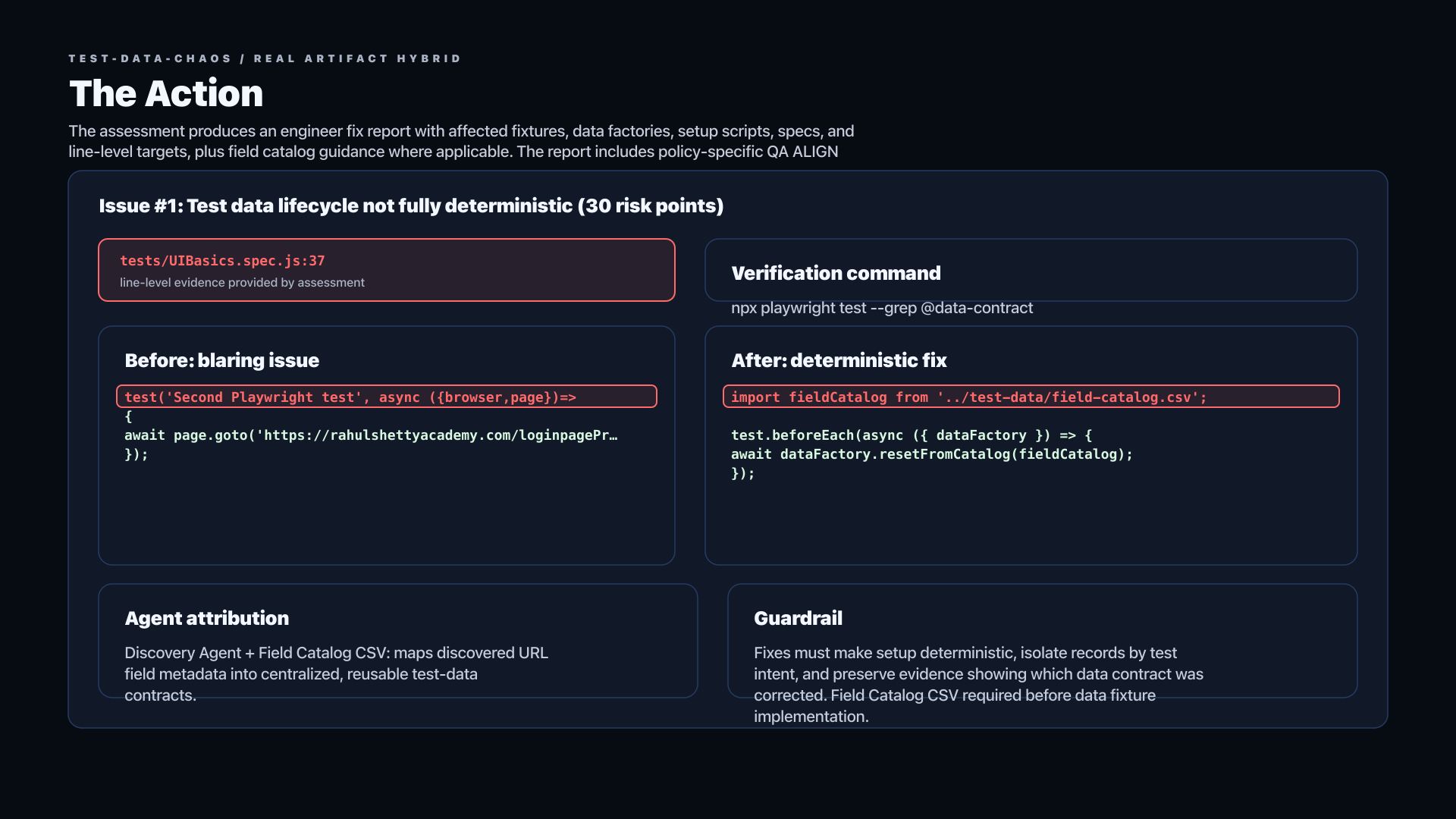
Test Data Chaos engineer fix plan targeting Field Catalog contract

3. What the fix plan says

The fix plan points to the CSV Data Gatherer and Field Catalog contract so hidden setup knowledge becomes reusable test data.

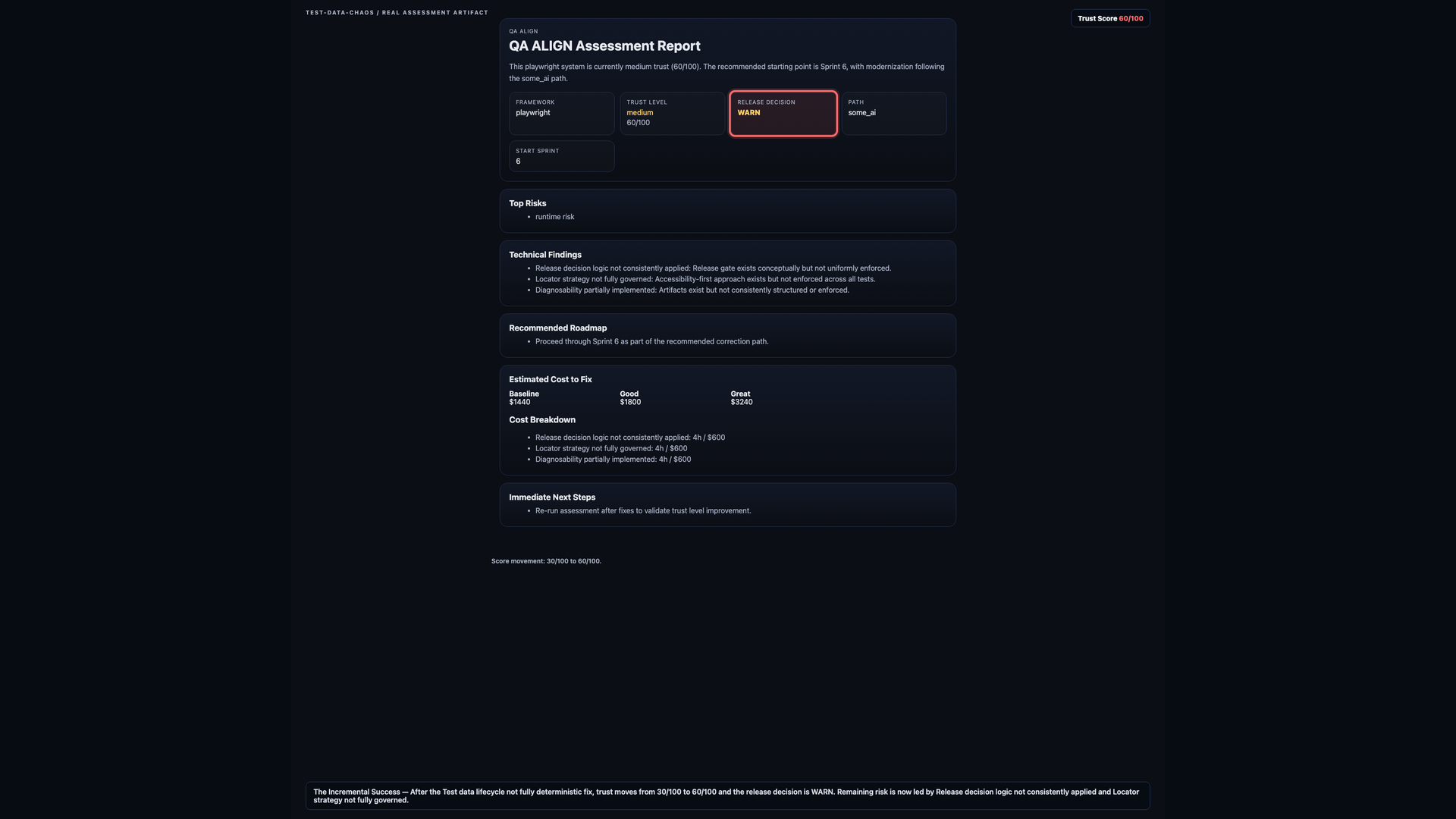
Test Data Chaos rerun report showing 60/100 WARN

4. New report after rerun

After the Field Catalog repair path, trust improves from 30/100 to 60/100 and the release decision becomes WARN, not GO.

Report outcomes

Know what is breaking trust before buying remediation

  • Know which data patterns are reducing trust
  • Separate data contamination from product and framework failures
  • Understand which setup and reset contracts are missing
  • Receive a Field Catalog CSV when URL discovery/test creation is part of the engagement
  • Review weighted pricing for data-control fixes
  • Give engineers a faster internal implementation path

Request the report

Only your email is required to begin. Add technical context only if it is useful.

Add optional context

Private intake. The external report is for your team. Internal engineer fix docs are not public-facing.