






Weak Artifact Evidence

Stop Guessing at Failures with Deterministic Artifact Contracts

QA ALIGN queries the framework for missing, inconsistent, or low-value artifacts, then maps the fixes needed to produce structured failure artifact contracts.

External report for the client. Internal engineer fix document is created after approval to accelerate remediation.

Experienced improving systems for:

What QA ALIGN queries

Anti-patterns hiding inside the current framework

  • Artifacts are generated inconsistently across local and CI runs
  • Screenshots lack step, assertion, data, or environment context
  • Trace and video are unavailable for the failures that matter
  • Failure output is not stored as a JSON contract with severity, evidence, and trace ID
  • Console, network, and backend logs are disconnected from test output
  • Artifact links expire, move, or require tribal knowledge to find
What the client receives

An external report with issues, trust level, and prices

  • Detected framework anti-patterns with affected areas
  • Current framework trust level
  • Issue evidence and severity
  • Weighted prices to fix the recommended changes
  • Recommended first remediation path

Sample finding

Artifacts exist but do not explain the failure

A screenshot alone rarely answers why a failure happened. QA ALIGN checks whether artifacts connect the failing step to failure type, severity, trace, screenshot, console, network, data, and environment context.

Detected anti-pattern

The report prices the changes needed to turn raw artifacts into structured proof for engineering diagnosis, triage classification, and release decisions.

Current assessment scenario

Weak Artifact Evidence Client Assessment Story

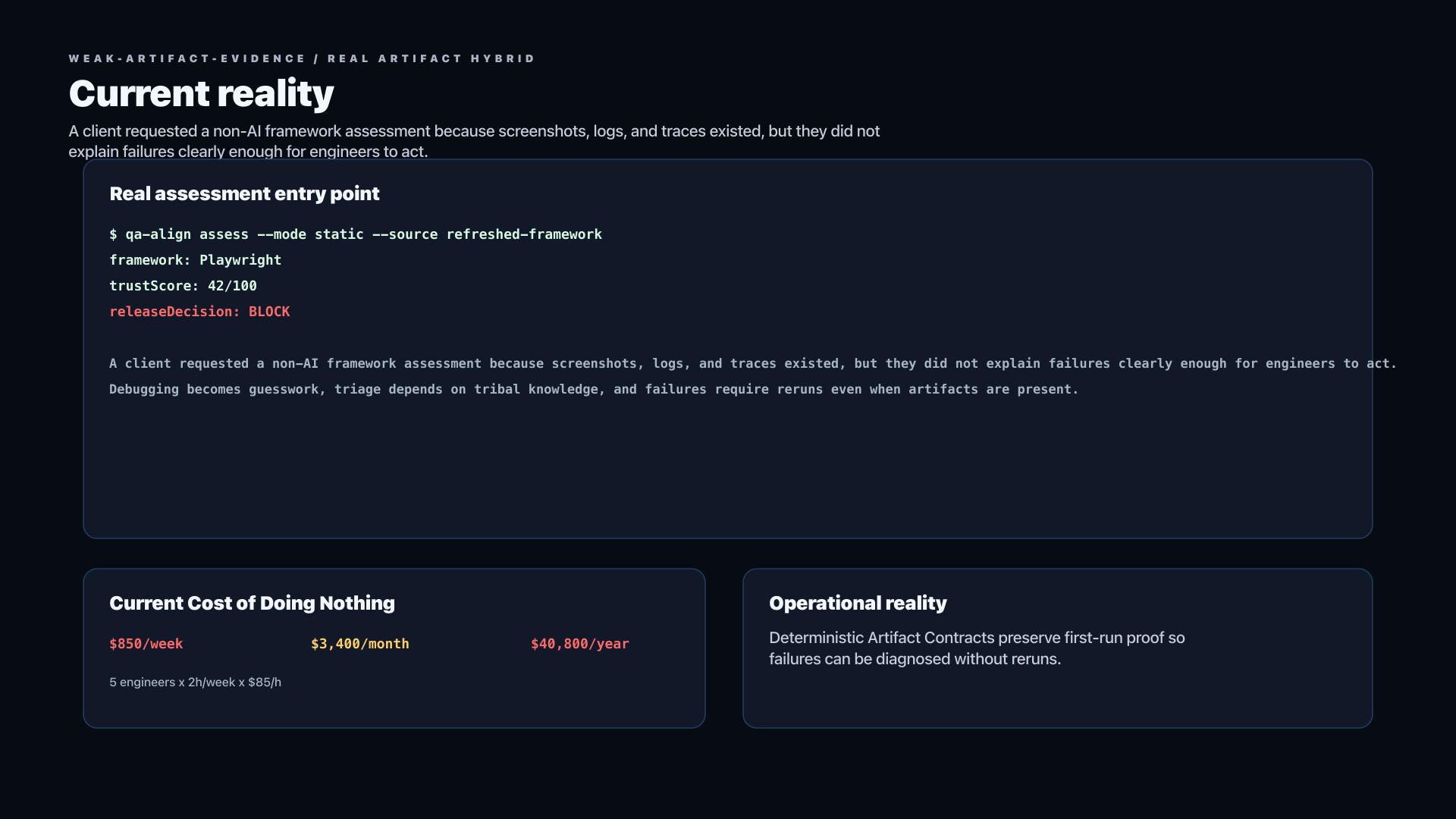
A client requested a non-AI framework assessment because screenshots, logs, and traces existed, but they did not explain failures clearly enough for engineers to act.

Weak Artifact Evidence Client Assessment Story assessment evidence preview
What QA ALIGN found

QA ALIGN found incomplete artifact contracts: evidence was captured inconsistently or disconnected from the report finding. The assessment produces an engineer fix report with affected reporter, trace, screenshot, and logging files plus line-level artifact contract improvements.

Evidence reviewed
  • Screenshot, log, and trace inventory
  • Artifact contract findings
  • Affected reporter files and line numbers
  • Rerun artifact completeness result
Assessment decision

After the artifact contract is enforced, the rerun report shows trust improved from 42 to 58. Release moves to WARN because manual triage is now the next highest risk.

Evidence chain proof

Four real snapshots from the Weak Artifact evidence-chain fix.

The evidence follows the broken chain from the raw issue through assessment, repair proof, and a rerun that improves trust to 58 while release moves to WARN.

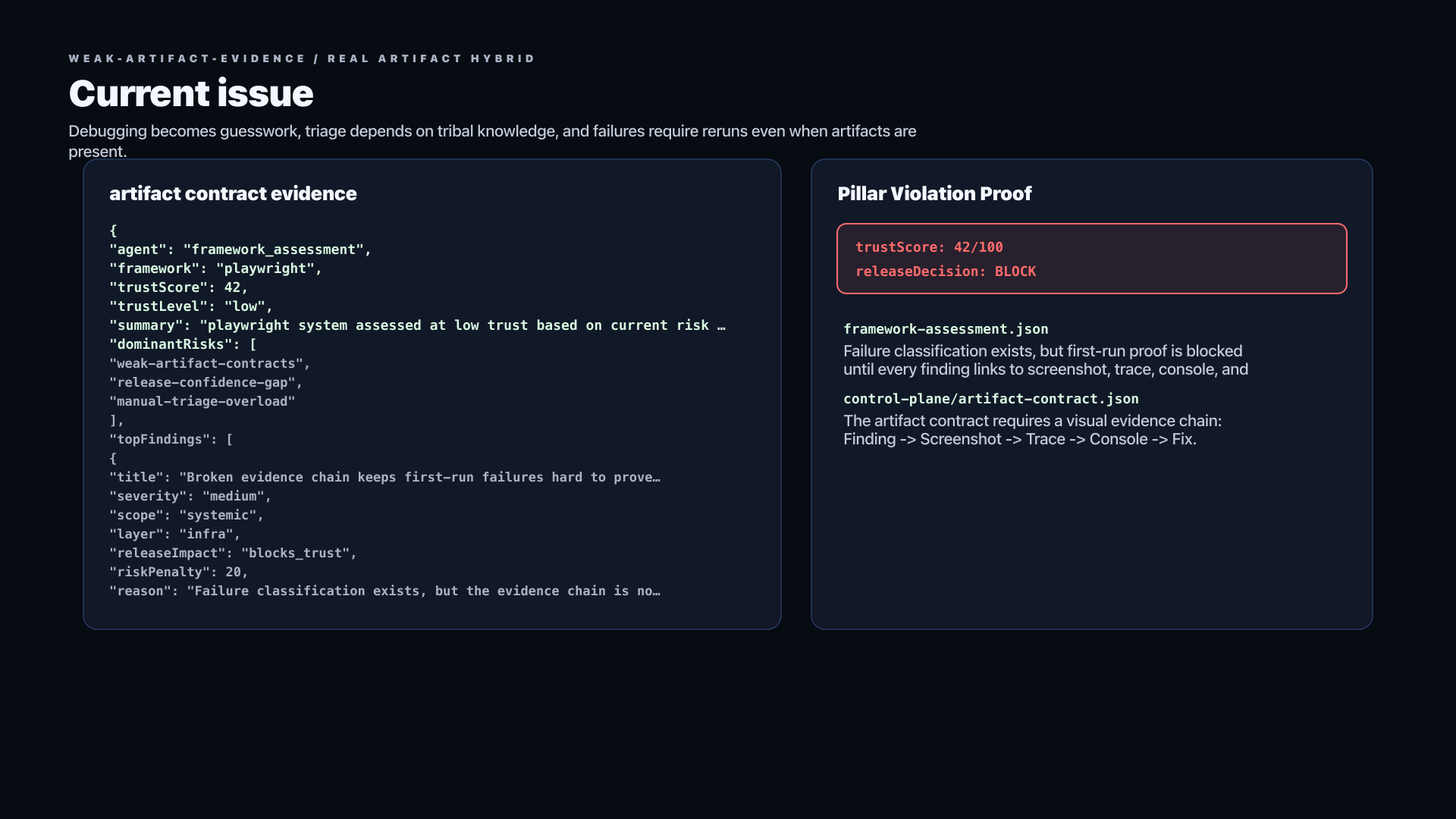
Weak Artifact Evidence raw issue showing broken evidence-chain artifact contract

1. The issue in JSON

The baseline snapshot shows the top finding: broken evidence-chain proof keeps first-run failures hard to prove, with the artifact contract still blocking release trust.

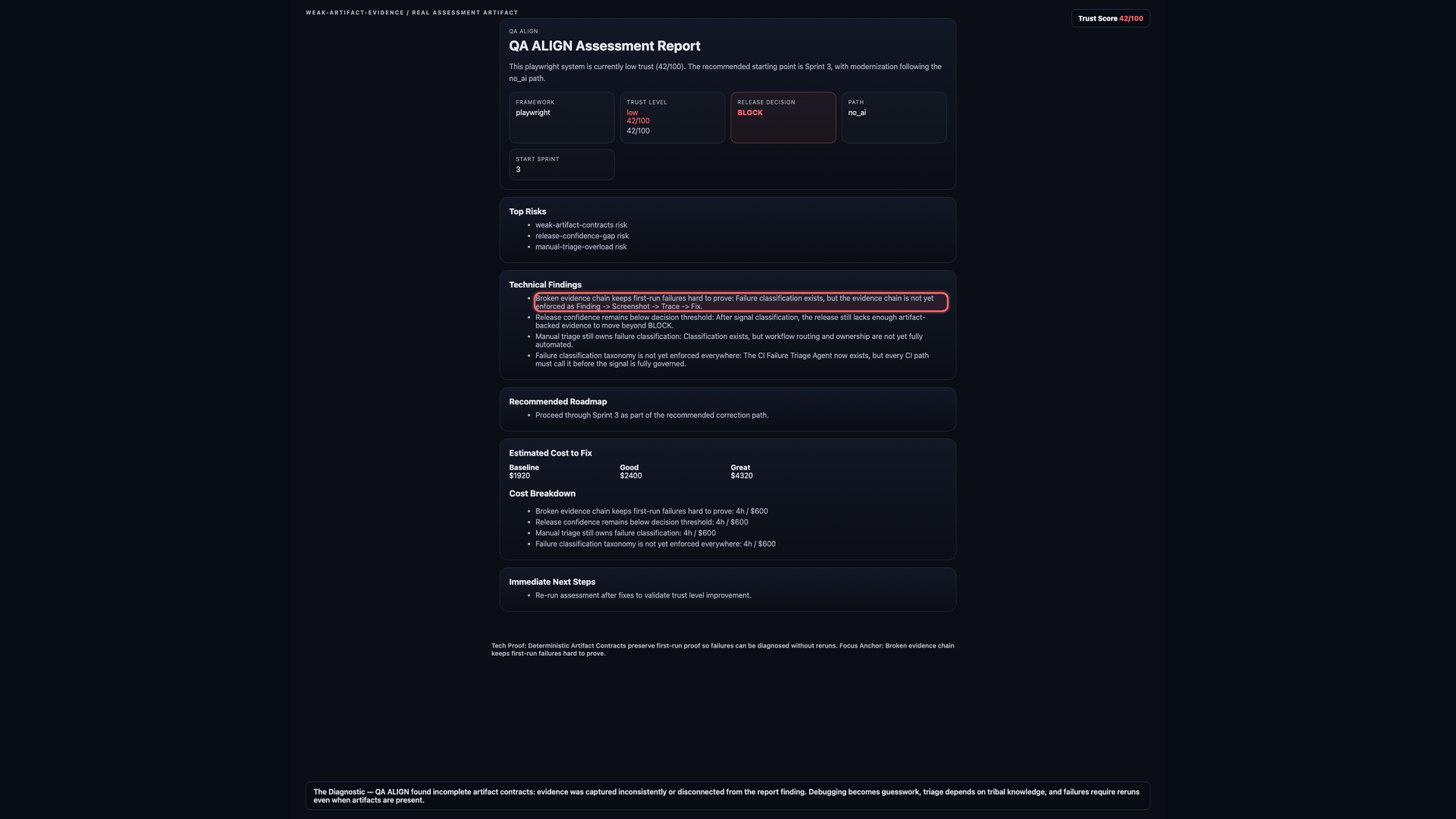
QA ALIGN report showing weak artifact evidence as the highlighted finding

2. How the report names it

The client report highlights 42/100 BLOCK and calls out that failures are not yet enforced as Finding, Screenshot, Trace, Console, and Fix evidence.

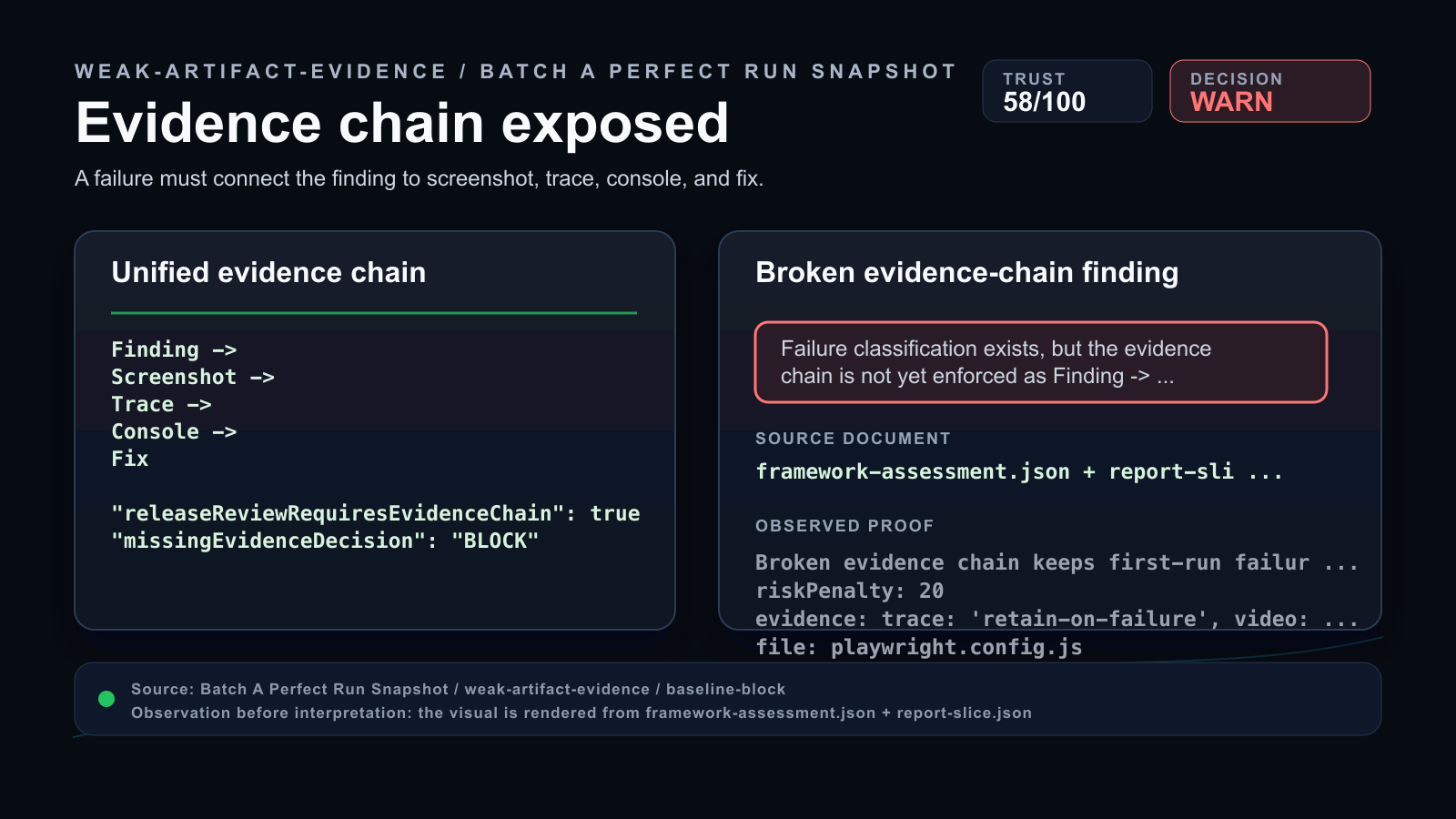
Evidence chain dashboard showing finding screenshot trace console and fix proof

3. What the fix plan says

The fix proof centers the artifact contract: every failure must connect the finding to screenshot, trace, console, and fix evidence before release review.

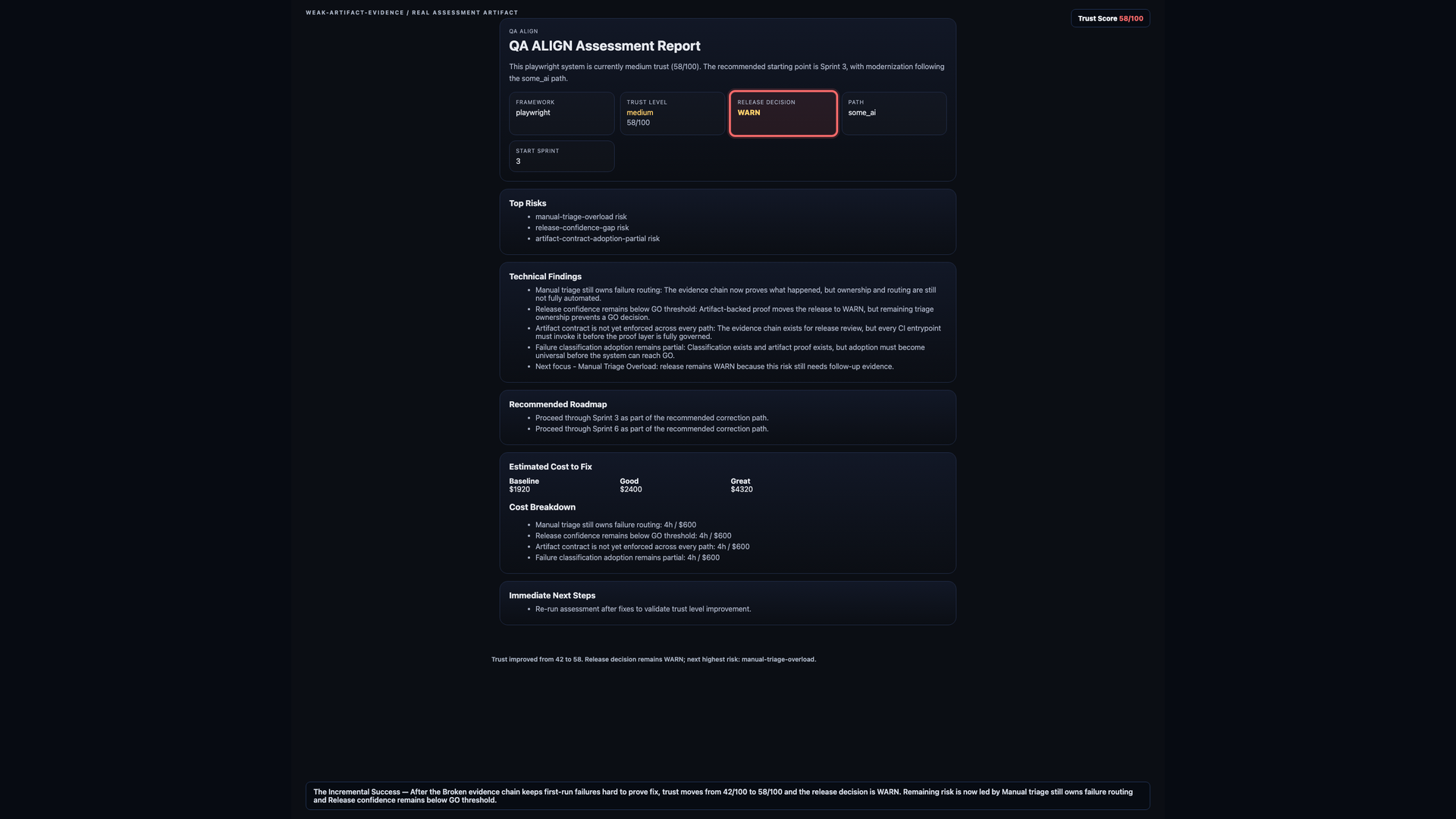
Weak Artifact Evidence rerun report showing trust score improved to 58 with WARN decision

4. New report after rerun

After the artifact contract is enforced, the rerun report shows trust improved from 42 to 58. Release moves to WARN because manual triage is now the next highest risk.

Durable operational capability

What Your Team Owns After This Engagement

QA ALIGN does not leave behind hours. The engagement leaves your team with operational assets, new framework capabilities, and measurable improvements it can continue using after the work ends.

The assessment selects a companion deterministic sprint grounded in established automation-engineering practices. The order matters: earlier sprints establish trusted signals, evidence, and controls, making each later improvement more valuable and easier to verify.

Companion sprint recommended by this assessment Sprint 3 — Evidence-chain enforcement

The assessment found that captured artifacts still did not prove every release-blocking finding from the first failed run.

Assets your team owns
  • Structured evidence-chain contract
  • Failure artifact retention policy
  • Line-level evidence remediation plan
Capabilities your team gains
  • Connect each finding to screenshot, trace, console, and fix evidence
  • Preserve first-run proof for release review
Operational improvements
  • Fewer reruns required to understand a failure
  • Faster diagnosis from preserved machine evidence

Verified by the 42/100 BLOCK to 58/100 WARN archived assessment pair.

Report outcomes

Know what is breaking trust before buying remediation

  • Know which artifacts are missing or low-value
  • See how artifact gaps affect current framework trust
  • Understand what structured failure artifact contract should exist after remediation
  • Connect JSON failure contracts to traces, screenshots, console logs, network evidence, and environment metadata
  • Debug from preserved proof without requiring a rerun
  • Review weighted pricing for artifact generation and retention fixes
  • Give engineers a faster internal implementation path

Request the report

Only your email is required to begin. Add technical context only if it is useful.

Add optional context

Private intake. The external report is for your team. Internal engineer fix docs are not public-facing.